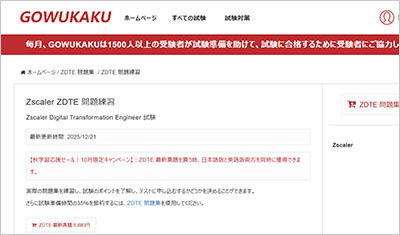
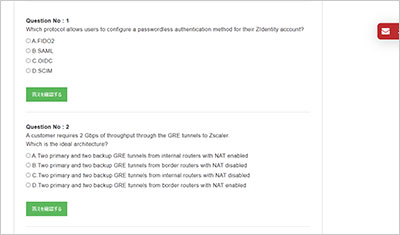
サンプル問題 1: What is the default classification for a newly discovered application in the App Inventory in the Third-Party App Governance Admin Portal?
A: Sanctioned
B: Unsanctioned
C: Reviewing
D: Unclassified
正解:D
Explanation: In Zscaler 3rd-Party App Governance documentation, the App Inventory is where administrators view and manage all discovered third-party apps, add-ons, and extensions. The “Classifying Apps” help article defines the available states: Unclassified, Sanctioned, Reviewing, and Unsanctioned. Crucially, it notes that Unclassified is the default state for any new application before an administrator evaluates it. “Sanctioned” is used once the organization has explicitly approved an app for use; “Unsanctioned” is used when an app is not allowed; and “Reviewing” indicates it is under investigation. Those labels are the result of governance decisions applied after discovery. ZDTE study materials on SaaS and app governance mirror this behavior: newly discovered apps enter the inventory without an explicit decision, allowing security teams to triage risk, review permissions, and only then mark them as sanctioned or unsanctioned. Because the default state for a new entry is explicitly documented as Unclassified, the correct answer is D. Unclassified
サンプル問題 2: How many rounds of analysis are performed on a sandboxed sample to determine its characteristics?
A: One static analysis, one dynamic analysis, and a second static analysis of all dropped files and artifacts from the dynamic analysis.
B: As many rounds of analysis as the policy is configured to perform.
C: Only a static analysis is performed.
D: Only one static and one dynamic analysis is performed.
正解:A
Explanation: Zscaler Cloud Sandbox is designed to detect advanced and previously unknown threats by deeply analyzing suspicious files in an isolated environment. According to Zscaler’s documented analysis pipeline, every sandboxed sample goes through a structured, multi-stage process rather than a single pass. First, the file undergoes static analysis, where the system inspects the file without executing it. This phase looks at elements such as structure, headers, embedded resources, and known malicious patterns or indicators. Next, the file is executed in a dynamic analysis environment (a sandbox) where Zscaler observes runtime behavior such as process creation, registry modifications, file system changes, network connections, and attempts at evasion or privilege escalation. During this dynamic phase, the file may drop or create additional files and artifacts. Zscaler then performs a second round of static analysis on those dropped components. This secondary static analysis is crucial because many sophisticated threats unpack or download their real payload only at runtime; analyzing those artifacts provides a much clearer view of the full attack chain. Because of this defined three-step approach―static, dynamic, then secondary static analysis on dropped artifacts―option A is the correct description of how many rounds of analysis are performed on a sandboxed sample.
サンプル問題 3: Which type of sensitive information can be protected using OCR (Optical Character Recognition) technology?
A: Personally Identifiable Information (PII)
B: Network configurations
C: Software licenses
D: Financial transactions
正解:A
Explanation: Zscaler’s Data Protection platform integrates Optical Character Recognition (OCR) into its inline Data Loss Prevention (DLP) capabilities. OCR enables Zscaler to extract text embedded within images―such as screenshots, scanned documents, or photos of forms―and subject that text to the same DLP inspection engines that normally analyze plain text content. Once OCR has converted image content into text, Zscaler can apply predefined dictionaries, custom dictionaries, and advanced classifiers to detect sensitive data types, including personally identifiable information (PII) such as national ID numbers, passport numbers, addresses, or other regulated personal data. This is crucial because many data leaks occur via screenshots or scanned documents that traditional, text-only DLP engines would miss. While OCR could, in theory, detect patterns related to network configurations, software licenses, or financial transactions, Zscaler’s training and exam materials emphasize its use to protect sensitive data in images― especially user-related regulated data such as PII and other compliance-relevant information. Network configurations and software licenses are better addressed through configuration management and IP protection policies, and “financial transactions” describes activities rather than a specific information pattern. Therefore, Personally Identifiable Information (PII) is the best and most exam-accurate answer for the type of sensitive information protected using OCR.
Zscaler ZDTE試験準備をしていますか?それとも自分は全部できそうです。復習する必要がないと思いますか?それとも自分は何もできないような気がします。どうすればいいでしょうか?実は、この問題を解決するのは難しくないです。勉強者がやるべきのは分解分析をマスターすることです。ここではZDTE問題集を使って学習中の課題を確認し、知識を整理してZscaler Digital Transformation Engineer試験の準備を進めます。
その次に、非常規の試験ポイントのテーマは多すぎてこだわる必要はなくて、重要な試験点のテーマはきっと知識の点をわかります。特にZscaler Digital Transformation Engineer試験は試験資料ポイントが多いです。一つの問題は知識ポイントだけではなく、復習する時はまとめをマスターして、記憶を分類します。知識ポイントが覚えていないか、間違えていないかのために点数をなくしてはいけません。