サンプル問題 1: A healthcare customer wants to Implement an FC SAN solution consisting of a NetApp ONTAP system, Broadcom switches, and servers. Which tool contains detailed blueprints and implementation references that can be used to design this solution?
A: NetApp Fusion
B: NetApp Verified Architecture
C: NetApp Active IQ Config Advisor
D: NetApp Active IQ Unified Manager
正解:B
Explanation: The correct tool for designing an FC SAN solution consisting of a NetApp ONTAP system, Broadcom switches, and servers is the "NetApp Verified Architecture" (NVA). The NetApp Verified Architecture provides comprehensive blueprints and detailed implementation references. These blueprints are thoroughly tested, prescriptive in nature, and designed to minimize deployment risks and accelerate time to market. They are specifically designed to help ensure that the architecture meets the high standards required for enterprise environments. NVA documents include design guides, best practices, and detailed configuration steps, making them invaluable for planning and deploying complex solutions like the one described. For more information, you can refer to the official NetApp documentation on NetApp Verified Architectures: NetApp Verified Architecture Program Summary NetApp Verified Architecture Overview These resources provide detailed insights into the architecture, including technology requirements, deployment procedures, and additional references for further reading
サンプル問題 2: An administrator is setting up a NetApp ONTAP AFF system for both NVMe/TCP and iSCSI. Which task is required for SAN configuration?
A: Configure CHAP authentication.
B: Configure DH-HMAC-CHAP authentication.
C: Configure LIFs.
D: Configure IPsec.
正解:C
Explanation: When setting up a NetApp ONTAP AFF system for both NVMe/TCP and iSCSI, a critical task required for SAN configuration is to configure Logical Interfaces (LIFs). LIFs are necessary for network connectivity and are used by both NVMe/TCP and iSCSI protocols to communicate between the storage system and the host. The configuration of LIFs involves creating and managing these interfaces to ensure they are correctly mapped and available for use by the respective protocols. This step is essential for the SAN setup to function properly. For more detailed steps on configuring LIFs, you can refer to NetApp's documentation: How to Configure NVMe/TCP with ONTAP (NetApp Community). SAN Configuration with ONTAP (NetApp).
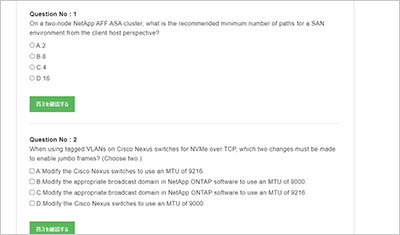
サンプル問題 3: What are two benefits of implementing VLANs for NVMe/TCP configurations? (Choose two.)
A: Increased resiliency
B: Reduced number of broadcast domains
C: Increased security
D: Reduced number of IPspaces
正解:A, C
Explanation: Implementing VLANs for NVMe/TCP configurations provides several benefits, two of which are increased resiliency and increased security: Increased Resiliency: VLANs help segment the network traffic, reducing the risk of a single point of failure. By isolating NVMe/TCP traffic into specific VLANs, network issues can be contained within a VLAN, preventing them from affecting other parts of the network. This isolation ensures that disruptions are minimized and network resiliency is enhanced. Increased Security: VLANs provide an added layer of security by segregating traffic. This segregation ensures that NVMe/TCP traffic is isolated from other types of traffic, reducing the risk of unauthorized access or data breaches. VLANs help in enforcing stricter access controls and monitoring, thereby increasing the overall security of the network. For more information on the benefits of VLANs in NVMe/TCP configurations, you can refer to NetApp's technical resources: Implementing and Configuring Modern SANs with NVMe-Of (NetApp). SAN Configuration Best Practices (NetApp Community).
NetApp NS0-521試験の準備に向けた復習資料としてNS0-521問題集を提供しています。Implementation Engineer - SAN ONTAP Exam試験の主要な知識ポイントをカバーしています。ページ上部の「NS0-521 試験を開始する」ボタンからオンライン無料サンプル問題を確認できます。
NS0-521問題集の収録内容と更新状況はどうなっていますか?
答え:現在提供されているNS0-521問題集には、NS0-521試験対策に向けた全65問の練習問題と解答が収録されています。Implementation Engineer - SAN ONTAP Exam試験に向けた復習に利用できます。