サンプル問題 1: A systems administrator is looking for a low-cost application-hosting solution that is cloud-based. Which of the following meets these requirements?
A: Serverless framework
B: Type 1 hvpervisor
C: SD-WAN
D: SDN
正解:A
Explanation: A serverless framework is a cloud-based application-hosting solution that meets the requirements of low-cost and cloud-based. A serverless framework is a type of cloud computing service that allows developers to run applications without managing or provisioning any servers. The cloud provider handles the server-side infrastructure, such as scaling, load balancing, security, and maintenance, and charges the developer only for the resources consumed by the application. A serverless framework enables developers to focus on the application logic and functionality, and reduces the operational costs and complexity of hosting applications. Some examples of serverless frameworks are AWS Lambda, Azure Functions, and Google Cloud Functions. A type 1 hypervisor, SD-WAN, and SDN are not cloud-based application-hosting solutions that meet the requirements of low-cost and cloud-based. A type 1 hypervisor is a software layer that runs directly on the hardware and creates multiple virtual machines that can run different operating systems and applications. A type 1 hypervisor is not a cloud-based service, but a virtualization technology that can be used to create private or hybrid clouds. A type 1 hypervisor also requires the developer to manage and provision the servers and the virtual machines, which can increase the operational costs and complexity of hosting applications. Some examples of type 1 hypervisors are VMware ESXi, Microsoft Hyper-V, and Citrix XenServer. SD-WAN (Software-Defined Wide Area Network) is a network architecture that uses software to dynamically route traffic across multiple WAN connections, such as broadband, LTE, or MPLS. SD-WAN is not a cloud-based service, but a network optimization technology that can improve the performance, reliability, and security of WAN connections. SD-WAN can be used to connect remote sites or users to cloud-based applications, but it does not host the applications itself. Some examples of SD-WAN vendors are Cisco, VMware, and Fortinet. SDN (Software-Defined Networking) is a network architecture that decouples the control plane from the data plane, and uses a centralized controller to programmatically manage and configure the network devices and traffic flows. SDN is not a cloud-based service, but a network automation technology that can enhance the scalability, flexibility, and efficiency of the network. SDN can be used to create virtual networks or network functions that can support cloud-based applications, but it does not host the applications itself. Some examples of SDN vendors are OpenFlow, OpenDaylight, and OpenStack. References = CompTIA Security+ SY0-701 Certification Study Guide, page 264-265; Professor Messer’s CompTIA SY0-701 Security+ Training Course, video 3.1 - Cloud and Virtualization, 7:40 - 10:00; [Serverless Framework]; [Type 1 Hypervisor]; [SD-WAN]; [SDN]
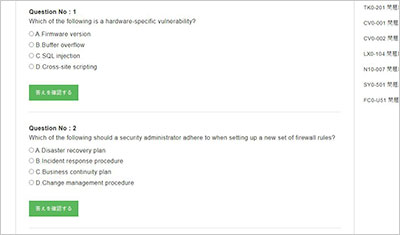
サンプル問題 2: Which of the following vulnerabilities is associated with installing software outside of a manufacturer’s approved software repository?
A: Jailbreaking
B: Memory injection
C: Resource reuse
D: Side loading
正解:D
Explanation: Side loading is the process of installing software outside of a manufacturer’s approved software repository. This can expose the device to potential vulnerabilities, such as malware, spyware, or unauthorized access. Side loading can also bypass security controls and policies that are enforced by the manufacturer or the organization. Side loading is often done by users who want to access applications or features that are not available or allowed on their devices. References = Sideloading - CompTIA Security + Video Training | Interface Technical Training, Security+ (Plus) Certification | CompTIA IT Certifications, Load Balancers C CompTIA Security+ SY0-501 C 2.1, CompTIA Security+ SY0-601 Certification Study Guide.
サンプル問題 3: A newly appointed board member with cybersecurity knowledge wants the board of directors to receive a quarterly report detailing the number of incidents that impacted the organization. The systems administrator is creating a way to present the data to the board of directors. Which of the following should the systems administrator use?
A: Packet captures
B: Vulnerability scans
C: Metadata
D: Dashboard
正解:D
Explanation: A dashboard is a graphical user interface that provides a visual representation of key performance indicators, metrics, and trends related to security events and incidents. A dashboard can help the board of directors to understand the number and impact of incidents that affected the organization in a given period, as well as the status and effectiveness of the security controls and processes. A dashboard can also allow the board of directors to drill down into specific details or filter the data by various criteria12. A packet capture is a method of capturing and analyzing the network traffic that passes through a device or a network segment. A packet capture can provide detailed information about the source, destination, protocol, and content of each packet, but it is not a suitable way to present a summary of incidents to the board of directors13. A vulnerability scan is a process of identifying and assessing the weaknesses and exposures in a system or a network that could be exploited by attackers. A vulnerability scan can help the organization to prioritize and remediate the risks and improve the security posture, but it is not a relevant way to report the number of incidents that occurred in a quarter14. Metadata is data that describes other data, such as its format, origin, structure, or context. Metadata can provide useful information about the characteristics and properties of data, but it is not a meaningful way to communicate the impact and frequency of incidents to the board of directors. References = 1: CompTIA Security+ SY0-701 Certification Study Guide, page 3722: SIEM Dashboards C SY0-601 CompTIA Security+ : 4.3, video by Professor Messer3: CompTIA Security+ SY0-701 Certification Study Guide, page 3464: CompTIA Security+ SY0-701 Certification Study Guide, page 362. : CompTIA Security+ SY0-701 Certification Study Guide, page 97.