IT認証試験問題集
GOWUKAKU|IT認定資格の最新の試験問題集(PDF版・無料サンプル問題)を提供しています
 ホームページ / ServSafe 問題集  / ServSafe Manager 問題集

ServSafe Manager 問題集 練習問題・模擬試験|日本語版&英語版対応

ServSafe Manager Exam 試験問題と答案

(0件のカスタマーレビュー)

最終更新日: 2026/10/20  収録内容確認済 | PDF問題集: 全 90 問収録

ServSafe Manager試験対策の学習資料(PDF版:日本語・英語2言語セット)|1年間(365日)無料アップデート付
ServSafe Manager 試験を開始する   
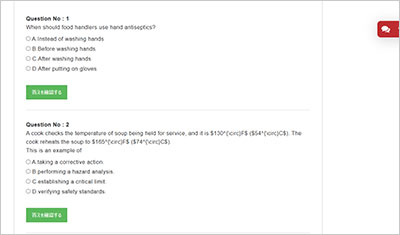
servsafe-manager_shiken_1
servsafe-manager_shiken_2

ServSafe Manager 問題集 仕様・サポート案内

対象試験 ServSafe Manager — ServSafe Manager Exam
収録問題数 全 90 問(解答付き/オンライン無料サンプル 30 問公開中)
提供形式・言語 PDF版(日本語版・英語版の2言語セット)
販売価格(税込) 6,880円(税込) ※1回払いの買い切り商品です。自動更新や追加請求はありません。
引き渡し・有効期間 決済完了後すぐにダウンロード可能(日本語版が準備中の科目は、英語版を即時ダウンロードのうえ、日本語版は準備完了次第ご登録メールへ自動送付・有効化されます)。ご購入日から1年間(365日間)無料アップデート対応(期間内の更新版も追加料金なしでダウンロード可能)。
お問い合わせ窓口 メールサポート:[email protected](注文確認・再送・教材に関するご質問|返金・交換条件)

ServSafe Manager サンプル問題プレビュー(抜粋)

収録内容から抜粋したサンプル問題です。「解答・解説を表示」をクリックすると正解を確認できます。

サンプル問題 1: Which food must be stored at a temperature of 41°F (5°C) or lower?

  • A: Ham-and-cheese sandwich
  • B: Beef jerky and cracker appetizers
  • C: Cookies-and-brownies tray
  • D: Fruit basket with uncut fruit
正解:A
Explanation: According to the ServSafe Manager curriculum and the FDA Food Code, foods that require Time/Temperature Control for Safety (TCS food) must be stored at an internal temperature of $41^{\circ}F$ ($5^{\circ}C$) or lower to inhibit the growth of pathogenic bacteria. A ham-and-cheese sandwich is a prime example of a TCS food because it contains protein-rich ingredients (meat and dairy) that are moist and neutral or slightly acidic―the ideal environment for bacterial multiplication. Ham is a processed meat that, while cured, still requires refrigeration to remain safe. Cheese is a dairy product that is also classified as a TCS food. When combined in a sandwich, the product becomes a "ready-to-eat" TCS food. If left in the Temperature Danger Zone―defined as the range between $41^{\circ}F$ and $135^{\circ}F$ ($5^{\circ}C$ and $57^{\circ}C$)―bacteria such as Staphylococcus aureus or Listeria monocytogenes can grow to dangerous levels. In contrast, beef jerky is a shelf-stable dried meat with low water activity ($a_w$), cookies and brownies are low-moisture baked goods, and uncut fruit (except for certain melons, tomatoes, and leafy greens once cut) is generally not considered a TCS food. Proper storage at $41^{\circ}F$ or lower ensures that the sandwich remains safe for the duration of its shelf life, which is typically a maximum of seven days if prepared on-site. Managers must ensure that refrigerated storage units are calibrated and that the internal temperature of the food, not just the ambient air of the cooler, remains at or below the $41^{\circ}F$ threshold

サンプル問題 2: Which is an example of "cleaning"?

  • A: Checking the final rinse temperature in the dishwasher
  • B: Spraying a solution of bleach on a cutting board
  • C: Removing food bits from a slicer with a wiping cloth
  • D: Using a dry towel to remove spots from wine glasses
正解:C
Explanation: In a professional foodservice environment, ServSafe makes a critical distinction between "cleaning" and "sanitizing." Cleaning is the physical process of removing food, dirt, and other visible soil from a surface. Removing food bits from a slicer with a wiping cloth is a direct example of cleaning. This step is the essential first phase in the five-step process for cleaning and sanitizing: (1) Scrape or remove food bits, (2) Wash the surface, (3) Rinse the surface, (4) Sanitize the surface, and (5) Allow the surface to air-dry. Without the initial cleaning step, the subsequent sanitizing step will be ineffective. Soil and food particles can neutralize chemical sanitizers like chlorine or quaternary ammonium, or they can act as a physical shield that prevents the sanitizer from reaching and killing microorganisms. Options A and B describe monitoring and the act of sanitizing, respectively. Option D is a cosmetic action (polishing) that does not necessarily meet the hygienic definition of cleaning in a food-safety context. Effective cleaning requires the use of a detergent and physical labor (scrubbing or wiping) to break the surface tension of the soil. For equipment like meat slicers, this process is high-risk and must be performed at least every four hours if the equipment is in constant use. Managers must verify that staff are not skipping the "wash and rinse" phases before applying sanitizer. By removing the visible "bits" and "grease," the food handler ensures that the environment is prepared for the reduction of pathogens to safe levels.

サンプル問題 3: Which of the following practices of dispensing single-service items prevents contamination?

  • A: Provide individually wrapped ware.
  • B: Place unwrapped items in clean and sanitary dispensers.
  • C: Distribute the unwrapped items to the customer upon request.
  • D: Display unwrapped and left upright in containers with handles down.
正解:A
Explanation: Single-service items, such as plastic forks, spoons, and knives, are designed to be used once and then discarded. Because they cannot be cleaned and sanitized after being touched by a customer, they must be protected from contamination before use. Providing individually wrapped ware is the most effective method for preventing contamination. The wrapping acts as a physical barrier against dust, droplets from coughs or sneezes, and, most importantly, the hands of other customers or employees. The ServSafe standards emphasize that the "Flow of Food" includes the service stage, where cross-contamination is a frequent risk. If items are not wrapped, they must be dispensed in a way that the customer touches only the item they are taking. Placing unwrapped items in a bin where customers must reach in (Option D) is a major violation, as it allows for "hand-to-item" contamination. Even if items are placed "handles down," there is a high risk that a customer will accidentally touch the "business end" (the tines of a fork or the bowl of a spoon) of an adjacent utensil. While sanitary dispensers (Option B) are an approved method if they1 dispense 2one item at a time by the handle, individual wrapping (Option A) provides a superior level of protection during transport, storage, and customer self-service. Managers are responsible for ensuring that any single-service items that become soiled or are touched by customers are discarded immediately. This protocol is part of a larger strategy to minimize bare-hand contact with surfaces that will touch a customer's mouth.

GOWUKAKUのServSafe Manager問題集は、ServSafe ServSafe Manager Exam認定試験の準備に向けた復習用問題集です。ServSafe Manager問題集を使用して出題形式を確認し、知識の定着度を確認しながら復習を進めることができます。

ServSafe Manager問題集を使用する正しい方法

ServSafe Manager問題集を使用する正しい方法:間違いがない、または間違えた場合は、マークを付け、エラーの根本原因を見つけて統合し、習熟するまで確認します。

  • 問題演習は、Food Protection Manager試験に向けた現在の理解度を点検するためのステップです。間違えた設問を分析し、なぜ誤ったのかを確認して知識を定着させることが重要です。

  • ServSafe Manager試験に合格するには、主題の知識と試験のルールを習得する必要があります。そして、質問をせずに本を読んでビデオを見るだけでは、明らかに後者のことはできません。慎重に考えて要約することによってのみ、質問のルールを習得し、半分の労力で2倍の結果を得ることができます。

ServSafe Manager問題集レビューを使用するメリット

ServSafe Manager問題集を使用して、より多くの試験の質問を行うことで研究の問題を見つけてください。そうすれば、より良くなることができます。

  • ServSafe Manager試験の質問に関係することは当然可能です。繰り返しテストされる質問は、頻繁にテストされる質問です。質問に表示されないものは、テストされる可能性が最も低いものです。何度も何度もテストを受ける人は、当然、それを習得するために多くの時間とエネルギーを費やす必要があり、テストをあまり受けない人は、勉強する時間があるまで待つことができます。

  • 質問の結果から、それが正しいかどうかを確認できます。非常に重要なことでも、毎回読む必要はありません。問題が発生し、それが正しく行われていることがわかった場合、それ以上投資する必要はありません。そして、概念と原則の理解に自信があり、それでも問題を解決できない場合でも、それは幻想であり、同様の問題が実際に解決されるまで再試行する必要があることを意味します。

本を読んだりビデオを見たりすることのデメリット

本を読んだりビデオを見たりすることは大きな問題であり、役に立たないかもしれません。多くの人が本を読んだりビデオを見たりして試験の準備をしています。最初から最後まで、何度も見て、効率は高くありません。

  • 出題範囲が広いため、参考書を通読するだけでは重点分野と弱点の区別がつきにくくなります。

  • 参考書を読んで理解したつもりでも、実際にServSafe Managerの設問形式で問われると解答に迷うケースが少なくありません。

参考書や解説動画も基礎学習には有効ですが、ServSafe Manager試験の直前期には、問題演習で弱点を把握したうえで該当箇所を確認する使い方が効率的です。

間違えて理解できなくなったら、すぐに本に行きましょう。本を読んだりビデオを見たりする場合と比較して、本を検索する利点は、目的がより明確でアクティブになるため、印象がより深く、覚えやすくなることです。

アップデートについて

ご入金後、マイページからServSafe Manager試験問題集の日本語版と英語版の2言語セット(PDF形式)をダウンロードできます。また、試験範囲の改訂や問題集の更新が行われた場合、ご購入日から1年間(365日間)は更新版を追加料金なしでダウンロードできます。返金の条件は返金ポリシーに従います。

コメントを残す

採点

ServSafe