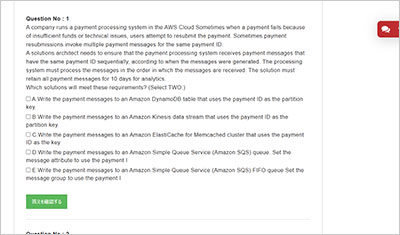
サンプル問題 1: A company collects temperature, humidity, and atmospheric pressure data in cities across multiple continents. The average volume of data collected per site each day is 500 GB. Each site has a high-speed internet connection. The company's weather forecasting applications are based in a single Region and analyze the data daily. What is the FASTEST way to aggregate data from all of these global sites?
A: Enable Amazon S3 Transfer Acceleration on the destination bucket. Use multipart uploads to directly upload site data to the destination bucket.
B: Upload site data to an Amazon S3 bucket in the closest AWS Region. Use S3 cross-Region replication to copy objects to the destination bucket.
C: Schedule AWS Snowball jobs daily to transfer data to the closest AWS Region. Use S3 cross-Region replication to copy objects to the destination bucket.
D: Upload the data to an Amazon EC2 instance in the closest Region. Store the data in an Amazon Elastic Block Store (Amazon EBS) volume. Once a day take an EBS snapshot and copy it to the centralized Region. Restore the EBS volume in the centralized Region and run an analysis on the data daily.
正解:A
Explanation: You might want to use Transfer Acceleration on a bucket for various reasons, including the following: You have customers that upload to a centralized bucket from all over the world. You transfer gigabytes to terabytes of data on a regular basis across continents. You are unable to utilize all of your available bandwidth over the Internet when uploading to Amazon S3. https://docs.aws.amazon.com/AmazonS3/latest/dev/transfer-acceleration.html https://aws.amazon.com/s3/transfer- acceleration/#:~:text=S3%20Transfer%20Acceleration%20(S3TA)%20reduces,to%20S3%20for%20rem ote%20applications: "Amazon S3 Transfer Acceleration can speed up content transfers to and from Amazon S3 by as much as 50-500%for long-distance transfer of larger objects. Customers who have either web or mobile applications with widespread users or applications hosted far away from their S3 bucket can experience long and variable upload and download speeds over the Internet" https://docs.aws.amazon.com/AmazonS3/latest/userguide/mpuoverview.html "Improved throughput - You can upload parts in parallel to improve throughput."
サンプル問題 2: A company needs the ability to analyze the log files of its proprietary application. The logs are stored in JSON format in an Amazon S3 bucket Queries will be simple and will run on-demand A solutions architect needs to perform the analysis with minimal changes to the existing architecture What should the solutions architect do to meet these requirements with the LEAST amount of operational overhead?
A: Use Amazon Redshift to load all the content into one place and run the SQL queries as needed
B: Use Amazon CloudWatch Logs to store the logs Run SQL queries as needed from the Amazon CloudWatch console
C: Use Amazon Athena directly with Amazon S3 to run the queries as needed
D: Use AWS Glue to catalog the logs Use a transient Apache Spark cluster on Amazon EMR to run the SQL queries as needed
正解:C
Explanation: Amazon Athena can be used to query JSON in S3
サンプル問題 3: A company uses AWS Organizations to manage multiple AWS accounts for different departments. The management account has an Amazon S3 bucket that contains project reports. The company wants to limit access to this S3 bucket to only users of accounts within the organization in AWS Organizations. Which solution meets these requirements with the LEAST amount of operational overhead?
A: Add the aws:PrincipalOrgID global condition key with a reference to the organization ID to the S3 bucket policy.
B: Create an organizational unit (OU) for each department. Add the aws:PrincipalOrgPaths global condition key to the S3 bucket policy.
C: Use AWS CloudTrail to monitor the CreateAccount, InviteAccountToOrganization, LeaveOrganization, and RemoveAccountFromOrganization events. Update the S3 bucket policy accordingly.
D: Tag each user that needs access to the S3 bucket. Add the aws:PrincipalTag global condition key to the S3 bucket policy.
正解:A
Explanation: https://aws.amazon.com/blogs/security/control-access-to-aws-resources-by-using-the-aws-organization-of-iam-principals/ The aws:PrincipalOrgID global key provides an alternative to listing all the account IDs for all AWS accounts in an organization. For example, the following Amazon S3 bucket policy allows members of any account in the XXX organization to add an object into the examtopics bucket. {"Version": "2020-09-10", "Statement": { "Sid": "AllowPutObject", "Effect": "Allow", "Principal": "*", "Action": "s3:PutObject", "Resource": "arn:aws:s3:::examtopics/*", "Condition": {"StringEquals": {"aws:PrincipalOrgID":["XXX"]}}}} https://docs.aws.amazon.com/IAM/latest/UserGuide/reference_policies_condition-keys.html