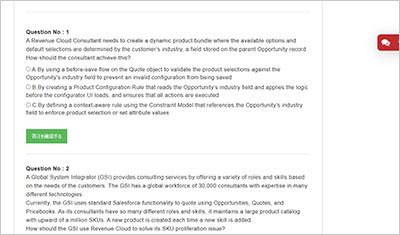
サンプル問題 1: A Revenue Cloud Consultant needs to display a list of products to be shown in the browse phase of a guided selling journey. Which Product Catalog Management business API should the consultant use to retrieve a list of products that belong to a specific catalog?
A: Products List (GET)
B: Product Related Records List (POST)
C: Products List (POST)
正解:C
Explanation: The Products List (POST) API is the correct choice for retrieving a list of products belonging to a specific catalog during the browse phase of guided selling in Revenue Cloud. This API endpoint is specifically designed as a composite API for Product Discovery and provides comprehensive filtering capabilities. According to the Revenue Cloud Developer Guide, the Products List (POST) resource is located at /connect/cpq/products and accepts POST requests with a JSON body. This API allows consultants to specify multiple parameters including catalogId, categoryId, price BookId, product ClassificationId, and various filtering criteria. The POST method is preferred over GET because it can handle complex request bodies with multiple filter criteria, user context information, and qualification/pricing procedures. The API supports essential Product Discovery features such as enable Qualification and enable Pricing flags, which are critical during the browse phase. It can also include context Definition and context Mapping parameters to ensure proper data flow during guided selling. The Products List (POST) returns a paginated list of products with complete details including pricing information, qualification status, and catalog associations. Option A (Products List GET) does not exist as a standard Product Catalog Management business API. Option B (Product Related Records List POST) is used for retrieving related records like Product Ramp Segment or Product Usage Grant, not for product lists. The Products List (POST) API is explicitly documented in the Product Discovery Business APIs section of the Revenue Cloud Developer Guide for browsing and discovering products during the sales transaction process. Reference: Revenue Cloud Developer Guide - Product Discovery Business APIs, Product Catalog Management Business APIs section
サンプル問題 2: A solution is being designed for migrating a customer's install base to Revenue Cloud. The customer states that it is extremely critical for the installed base to work fine in Revenue Cloud so that there is no business disruption, as a large part of their business is Amendments and Renewals. Apart from the Product, Product Selling Model, and Pricebook, which other key objects should be included in the discovery to help design this migration?
A: Asset, Asset Action, Asset State Period, Asset Action Source
B: Asset, Subscription, Subscribed Asset, Order
C: Quote, Quote Line, Order, Order Product
正解:A
Explanation: For migrating an install base to Revenue Cloud with focus on Amendments and Renewals, the correct objects are Asset, Asset Action, Asset State Period, and Asset Action Source. These objects form the foundation of Revenue Cloud's Asset Lifecycle Management, which is essential for tracking customer subscriptions and enabling amendment and renewal processes. The Asset object represents products or services that customers have purchased and own. It contains critical information about what the customer has, including quantity, pricing, and contract relationships. The Asset Action object tracks all changes made to assets throughout their lifecycle, including new purchases, amendments, renewals, and cancellations. Each asset action creates a historical record of modifications. Asset State Period is crucial as it represents time spans when an asset has the same quantity, amount, and monthly recurring revenue (MRR). According to the Revenue Cloud Developer Guide, "An asset has as many asset state periods as there are changes to it (asset actions) during its lifecycle." This object is essential for accurate revenue recognition and reporting. Asset Action Source links back to the originating transaction (Quote or Order) that created or modified the asset, maintaining data lineage. This traceability is vital for amendments and renewals, as Revenue Cloud needs to understand the complete history of each asset. Option B includes legacy CPQ objects (Subscription, Subscribed Asset) that are not part of Revenue Cloud's asset management model. Option C focuses on transactional objects rather than asset tracking. The Asset Lifecycle Management objects in Option A are specifically designed to support the amendment and renewal workflows that are critical to the customer's business requirements. Reference: Revenue Cloud Developer Guide - Asset Lifecycle Standard Objects, Asset State Period object documentation, Asset Lifecycle Management
サンプル問題 3: Universal Containers is expanding into French- and German-speaking regions. The team wants to ensure that product names and descriptions appear in the correct language when customers browse the catalog via APIs. Which configuration is required to support this multilingual API response?
A: Use data translation via Translation Workbench to modify the metadata API and Product List API
B: Provide data translations using standard Salesforce Product2 APIs and Product Details API
C: Enable data translation and provide values via the Product List API and Product Details API
正解:C
Explanation: To support multilingual product catalog data through APIs in Revenue Cloud, the correct approach is to enable data translation and provide translated values that become available via the Product List API and Product Details API. This is a data translation feature specific to Product Catalog Management, distinct from metadata translation. According to Salesforce Help documentation for Product Catalog Management, administrators must first enable data translation and add supported languages. Once enabled, they can provide translations for Product Name, Product Description, and Help Text fields. Critically, "The translated data for Product Name, Product Description, and Help Text fields is available via the Product List API, Product Details API, and Bulk Product Details API." This data translation capability operates at the data level, not the metadata level. Translation Workbench is used for translating user interface elements and metadata, but for product catalog data consumed by APIs, the Product Catalog Management data translation feature is the correct approach. The system stores translated values and returns them based on the user's language context when API calls are made. Option A incorrectly suggests using Translation Workbench to modify APIs, which is not the correct mechanism. Option B mentions standard Product2 APIs without the data translation enablement step. The proper sequence requires enabling data translation in Product Catalog Management settings, providing translated values for products and categories, and then accessing this data through the Product List API and Product Details API, which automatically return content in the appropriate language based on request context. Reference: Salesforce Help - Set Up Data Translation in Product Catalog Management, Product Catalog Management Data Translation documentation