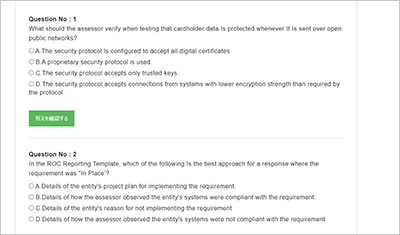
サンプル問題 1: Which of the following is true regarding internal vulnerability scans?
A: They must be performed after a significant change.
B: They must be performed by an Approved Scanning Vendor (ASV).
C: They must be performed by QSA personnel.
D: They must be performed at least annually.
正解:A
Explanation: Comprehensive Detailed Step by Step Explanation with All PCI DSS and Qualified Security Assessor V4 References Relevant PCI DSS Requirement: Internal vulnerability scans are discussed under PCI DSS Requirement
サンプル問題 2: Security policies and operational procedures should be?
A: Encrypted with strong cryptography.
B: Stored securely so that only management has access.
C: Reviewed and updated at least quarterly.
D: Distributed to and understood by ail affected parties.
正解:D
Explanation: Requirement Context: PCI DSS Requirement 12.5 mandates that security policies and operational procedures are not only documented but also distributed to relevant parties to ensure clarity and compliance. Importance of Distribution and Awareness: All affected parties, including employees, contractors, and third parties with access to the cardholder data environment (CDE), must receive and understand the policies. This ensures they adhere to the security measures. Review and Updates: Security policies must be kept up to date and reviewed at least annually or after significant changes in the environment. While other options such as encryption or restricted access are important for security, the critical focus is on distribution and awareness to ensure operational effectiveness. Testing and Validation: During assessments, QSAs validate the implementation by examining training records, communication logs, and acknowledgment forms signed by affected parties. Relevant PCI DSS v4.0 Guidance: Section 12.5.1 of PCI DSS v4.0 outlines that the dissemination of policies must ensure that all personnel understand their roles in securing the environment.
サンプル問題 3: Which of the following is true regarding compensating controls?
A: A compensating control is not necessary if all other PCI DSS requirements are in place.
B: A compensating control must address the risk associated with not adhering to the PCI DSS requirement.
C: An existing PCI DSS requirement can be used as compensating control if it is already implemented.
D: A compensating control worksheet is not required if the acquirer approves the compensating control.
正解:B
Explanation: Compensating Controls Definition and Purpose A compensating control is an alternate measure that satisfies the intent of a specific PCI DSS requirement and provides an equivalent level of security. The rationale and risk mitigation must be explicitly documented using the Compensating Control Worksheet (CCW). Mandatory Documentation PCI DSS v4.0 mandates the use of a CCW when implementing compensating controls. This applies regardless of acquirer approvals. The CCW requires detailed documentation including: Constraints preventing the original requirement from being implemented. Justification for the compensating control. Description of the control and evidence of its effectiveness. Using Existing Requirements If an existing PCI DSS requirement (e.g., Requirement 5 for antivirus) is already implemented and can mitigate the risks of not meeting another requirement, it may qualify as a compensating control. Approval and Review Process QSAs must validate the implementation, effectiveness, and appropriateness of compensating controls during the assessment process