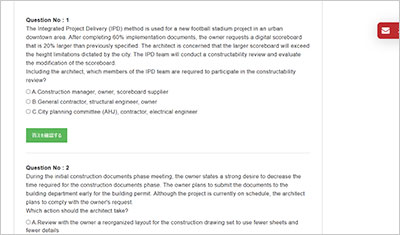
サンプル問題 1: According to ATA Document C401, Architect-Consultant Agreement, clearances and tolerances required by the mechanical work relative to the structural system are coordinated through which one of the following parties?
A: Structural engineer
B: Mechanical engineer
C: Architect
D: Contractor
正解:C
Explanation: According to the ATA Document C401, Architect-Consultant Agreement, the architect is responsible for coordinating clearances and tolerances required by mechanical work relative to the structural system. This means that the architect acts as the central coordinator among consultants, ensuring that mechanical systems fit properly within the structural framework without conflicts. The architect reviews mechanical engineer’s drawings and requirements for clearances and tolerances and communicates these needs to the structural engineer or contractor as necessary. This coordination helps prevent conflicts during construction and ensures the project integrates all disciplines smoothly. This responsibility falls on the architect because the architect oversees the entire project design and facilitates coordination among all consultants. Neither the structural engineer nor the mechanical engineer alone manages this coordination, and the contractor typically implements the work rather than designs or coordinates these specific technical clearances. Reference from ARE 5.0 Project Management (PjM) division: ATA Document C401 Architect-Consultant Agreement overview ― roles and responsibilities section Coordination and communication tasks assigned to the architect in multi-disciplinary projects Project Management guidelines emphasizing the architect’s role in consultant coordination
サンプル問題 2: The main goals on a large project are ease of communication and commitment from the project team. Which scheduling technique should be used?
A: Milestone chart
B: Interactive bar chart
C: Critical path method
正解:B
Explanation: Interactive bar charts are ideal for large projects where team commitment and communication are priorities. Unlike a simple milestone chart or the more complex Critical Path Method (CPM), interactive bar charts provide a visual, time-based representation of tasks that facilitates easy understanding across disciplines. When developed in a collaborative setting (such as pull-planning or in-person planning sessions), these charts help the project team see their roles, identify dependencies, and commit to deliverables. The ARE 5.0 Handbook (Project Management division) describes interactive bar charts as excellent tools for collaborative environments where schedule visibility and team accountability are essential. These charts promote communication across team members and are easier for non-technical stakeholders to interpret. Reference: NCARB ARE 5.0 Handbook C PjM Content Area 3: Project Work Planning
サンプル問題 3: An architect is evaluating a change order. Where should the costs for the project superintendent or general foreman be included?
A: Direct field labor hours
B: Direct field labor costs
C: Field overheads
D: General and administrative overheads
正解:C
Explanation: The costs associated with a project superintendent or general foreman are classified under field overheads. These are not directly tied to a specific construction activity (like labor laying concrete) but are necessary for managing and supervising the site work. Field overheads include site-specific expenses such as temporary facilities, safety equipment, and supervisory personnel costs. General and administrative overheads, by contrast, are associated with the contractor’s home office and not directly attributable to a specific project site. Reference: NCARB ARE 5.0 Handbook C PjM Content Area 2: Project Costs & Budgeting Reference: AIA Document G701 Commentary, AIA Best Practices