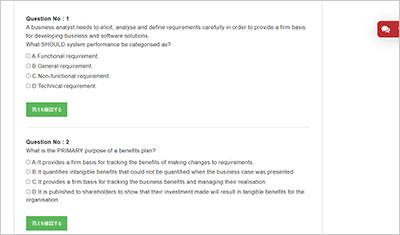
サンプル問題 1: At a recent Board Meeting the Directors of an office fitting company ratified the company's mission as: To meet or undercut all our competitors' prices' Which of the following is MOST LIKELY to be the company's vision?
A: To offer the best value office fitting service
B: To reduce the cost of office fitting by 5%.
C: To increase the company's market share.
D: To be the premier office fitting company
正解:A
Explanation: A mission statement defines the organization's purpose and primary objectives, often focusing on what the organization does and how it operates in the present. In contrast, a vision statement outlines the long-term aspirations of the organization―what it aims to become in the future. The mission provided―"To meet or undercut all our competitors' prices"―is focused on price competitiveness, which is a tactical approach rather than a strategic aspiration. Let’s analyze each option: A. To offer the best value office fitting service: While this aligns somewhat with the mission, it is more of a value proposition or operational goal rather than a visionary statement. It lacks the aspirational and long-term focus that defines a vision. B. To reduce the cost of office fitting by 5%: This is a specific, measurable objective, but it is too narrow and tactical to qualify as a vision. Visions are broader and not tied to specific metrics. C. To increase the company's market share: Increasing market share is a strategic goal, but it is still an intermediate step toward achieving something greater. It does not capture the overarching ambition of the company. D. To be the premier office fitting company: This option reflects a long-term aspiration and aligns with the characteristics of a vision statement. It expresses the desire to achieve leadership and excellence in the industry, which is consistent with the mission of being competitive on price while aiming for a higher status. According to the BCS Business Analysis Framework, a vision statement should inspire and guide the organization toward its ultimate goal. Therefore, D is the most appropriate choice
サンプル問題 2: The management of a chain of hotels has decided that one of its critical success factors (CSF) is to 'provide excellent customer service' The below measures have been suggested. Which THREE of these are appropriate key performance indicators (KPIs) for the CSF 'provide excellent customer service"?
A: The number of customers who make use of their in-room mini bar
B: The percentage of customers who use the leisure facilities
C: The number of customers who complain.
D: The percentage of customers who join the hotel loyalty scheme
E: The percentage of customers who return
正解:C, D, E
Explanation: To determine which measures are appropriate Key Performance Indicators (KPIs) for the Critical Success Factor (CSF) "provide excellent customer service," we must first understand the relationship between CSFs and KPIs: Critical Success Factors (CSFs): These are the essential areas or activities that an organization must excel at to achieve its goals. In this case, "provide excellent customer service" is a CSF. Key Performance Indicators (KPIs): These are measurable metrics used to evaluate progress toward achieving a CSF. KPIs should directly align with the CSF and provide actionable insights. Now, let’s evaluate each option to determine whether it is an appropriate KPI for the CSF "provide excellent customer service": A. The number of customers who make use of their in-room mini bar This measure tracks customer behavior related to a specific hotel amenity (the mini bar). While it may indicate customer satisfaction with the room's offerings, it does not directly measure the quality of customer service. Conclusion: This is not an appropriate KPI for the CSF "provide excellent customer service." B. The percentage of customers who use the leisure facilities This measure tracks how many customers utilize the hotel's leisure facilities (e.g., gym, pool, spa). While it may reflect customer engagement with the hotel's amenities, it does not directly assess the quality of customer service. Conclusion: This is not an appropriate KPI for the CSF "provide excellent customer service." C. The number of customers who complain Customer complaints are a direct indicator of dissatisfaction and can highlight areas where customer service needs improvement. A high number of complaints suggests poor customer service, while a low number indicates better service quality. This measure is closely aligned with the CSF "provide excellent customer service" because it provides actionable feedback on service performance. Conclusion: This is an appropriate KPI for the CSF. D. The percentage of customers who join the hotel loyalty scheme Customers are more likely to join a loyalty scheme if they have had a positive experience with the hotel, including excellent customer service. This measure reflects customer satisfaction and loyalty, which are outcomes of good service. Conclusion: This is an appropriate KPI for the CSF. E. The percentage of customers who return Repeat customers are a strong indicator of customer satisfaction and loyalty, which are directly influenced by the quality of customer service. If customers return to the hotel, it suggests they were satisfied with their previous experience, including the service they received. Conclusion: This is an appropriate KPI for the CSF.
サンプル問題 3: A report has been created into improving the scheduling of physio appointments at a major hospital An extract reads 'The scheduling team have a strong set of skills that will not need to be updated However, the team should be split into two. one dealing with inpatients and one with outpatients. The introduction of a new telephony software and an online booking system will also require changes to the process' How might these changes be BEST presented to communicate with the scheduling team'?
A: Business Process Model
B: Business Activity Model
C: POPIT
D: Prototype
正解:D
Explanation: To determine the best way to present the changes to the scheduling team, we need to consider the nature of the information being communicated and the audience (the scheduling team). The extract describes changes to processes, roles, and systems, which are best represented visually to ensure clarity and understanding. Key Considerations: Business Process Model (BPM): A BPM is a visual representation of the steps in a process. It is particularly useful for communicating changes to workflows, roles, and responsibilities. Since the extract discusses splitting the scheduling team into two groups and introducing new software and processes, a BPM would effectively illustrate how these changes impact the workflow. Business Activity Model (BAM): A BAM focuses on high-level activities and their logical dependencies, often used in strategic planning. However, it is less detailed than a BPM and may not adequately capture the specific changes to scheduling processes. POPIT (People, Organization, Process, Information, Technology): POPIT is a framework for analyzing business change across multiple dimensions. While it provides a holistic view, it is not a presentation tool and would not be the best choice for directly communicating the changes to the scheduling team. Prototype: A prototype is typically used to demonstrate the functionality of a system or software. While the introduction of telephony software and an online booking system could involve prototyping, this option does not address the need to communicate process and role changes. Evaluation of Each Option: A. Business Process Model: A BPM is ideal for illustrating the changes to the scheduling process, including the split into inpatient and outpatient teams and the integration of new software. It provides a clear, step-by-step visual representation that the scheduling team can easily understand. Conclusion: This is the best option. B. Business Activity Model: While a BAM could provide a high-level overview of the changes, it lacks the detail needed to explain specific process adjustments. Conclusion: This is not the best option. C. POPIT: POPIT is a framework for analysis, not a communication tool. It would not effectively convey the changes to the scheduling team. Conclusion: This is not the best option. D. Prototype: Prototyping is relevant for demonstrating software functionality but does not address the need to communicate process and role changes. Conclusion: This is not the best option. Final Recommendation: The changes should be presented using a Business Process Model, as it effectively communicates the revised workflows and roles to the scheduling team.
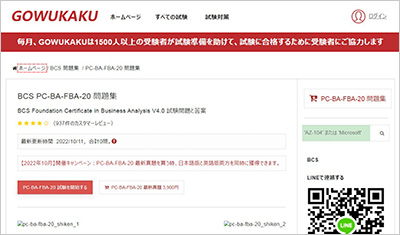
試験はこの世界で成功しやすいことの一つです。試験は前もって範囲を教えていますから、復習はこの範囲内の自分ができないところを探し続けています。GOWUKAKUはPC-BA-FBA-20問題集を用いたPC-BA-FBA-20(BCS Foundation Certificate in Business Analysis V4.0)試験の復習方法を案内しています。