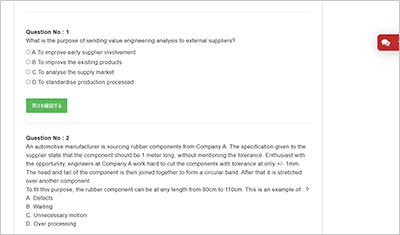
サンプル問題 1: A company uses eight different floor cleaning products at different premises and has decided to standardise on just one. This product is available from a large number of suppliers. What benefits should the company expect to achieve?
A: Lower costs
B: Fewer staff
C: Increased stock levels
D: Increased costs
正解:A
Explanation: Comprehensive and Detailed Explanation (paraphrased from CIPS L4M2 content) Standardising from many similar products to one common product is a classic variety reduction / standardisation decision. In CIPS L4M2, when standardisation is discussed, the benefits highlighted include: Economies of scale C buying larger quantities of a single product allows for better prices and volume discounts. Reduced administration and handling costs C only one product code to manage, fewer invoices and orders, simpler stock control. Simplified quality control C one specification and one performance profile to monitor. Because the product is available from many suppliers, competition remains strong. This supports lower prices, not higher. Option A (Lower costs) C correct, due to economies of scale and reduced process/handling complexity. Option B (Fewer staff) C staff numbers are driven by overall workload, not just the number of product variants; standardising doesn’t automatically cut headcount. Option C (Increased stock levels) C if anything, standardisation often reduces safety stock (you can pool demand into one line). Option D (Increased costs) C contradicts the expected benefits of standardisation and competition between many suppliers. Relevant CIPS L4M2 areas: Standardisation and variety reduction in specifications Economies of scale and cost drivers in sourcing decisions Managing supply markets with multiple potential suppliers
サンプル問題 2: A procurement manager decided to use a conformance specification in a request for quotation (RFQ) for the manufacturing of a specialist item designed by their company. The company does not have the capability to manufacture the item in-house, but requires the item to be made to their detailed specification. Was this the correct thing to do?
A: Yes, as it means that the company will be able to get the most cost-effective price for the item from the chosen supplier
B: No, as the item will be of non-standard construction and will not be able to be used by other competitors
C: No, as it means that the chosen supplier will not be able to use their expertise and knowledge to manufacture the item
D: Yes, as it means that the company will get exactly what it has specified and that the item meets its specific requirements
正解:D
Explanation: Comprehensive and Detailed Explanation (paraphrased from CIPS L4M2 content) CIPS L4M2 clearly distinguishes between conformance and performance specifications. A conformance specification describes exactly what the item must be like C dimensions, materials, design drawings, tolerances, etc. It is appropriate when the buyer already has a detailed design and simply wants the supplier to manufacture to that design. In this scenario: The buyer’s organisation has designed the specialist item and has a detailed specification. They cannot manufacture it in-house, but they need the item exactly as designed. This is precisely when CIPS says a conformance specification is appropriate: the purpose is to ensure the supplier delivers exactly what has been specified and that the item meets all the buyer’s technical and functional requirements. Option D matches this principle exactly. Option A mentions cost-effectiveness, which might happen, but it is not the main reason for using conformance specifications. Options B and C describe issues that are either irrelevant or are more associated with over-specification or missed innovation opportunities, not with the basic correctness of using conformance specifications in this situation. Relevant CIPS L4M2 areas: Types of specification: conformance vs performance vs outcome When to use buyer-designed (conformance) specifications Risks and benefits of restricting supplier design freedom
サンプル問題 3: Which of the following would be an example of direct costs for a decorating contractor?
A: Paint
B: Ladder
C: Van
D: Electricity
正解:A
Explanation: Comprehensive and Detailed Explanation (paraphrased from CIPS L4M2 content) CIPS L4M2 explains that direct costs are those that can be directly traced to a specific product, job, or project. For a decorating contractor: Paint (A) is clearly a direct cost C it is consumed on specific jobs, and the quantity and cost can be directly allocated to each project. Items such as: Ladder (B) C a piece of equipment used across many jobs. Its cost is typically spread over multiple projects; this makes it an indirect (overhead) cost. Van (C) C used for transport across many contracts, again an indirect or overhead cost. Electricity (D) C usually treated as an indirect or overhead cost, not allocated to a single job unless specially metered. Understanding the difference between direct and indirect costs is important for whole-life costing and building a business case, because misclassifying them can distort unit costs and profitability. Relevant CIPS L4M2 areas: Cost classification: direct vs indirect, fixed vs variable Costing and pricing in business cases Whole-life cost and cost build-up analysis
CIPS L4M2試験の準備に向けた復習資料としてL4M2問題集を提供しています。Defining Business Needs試験の主要な知識ポイントをカバーしています。ページ上部の「L4M2 試験を開始する」ボタンからオンライン無料サンプル問題を確認できます。
L4M2問題集の収録内容と更新状況はどうなっていますか?
答え:現在提供されているL4M2問題集には、L4M2試験対策に向けた全144問の練習問題と解答が収録されています。Defining Business Needs試験に向けた復習に利用できます。