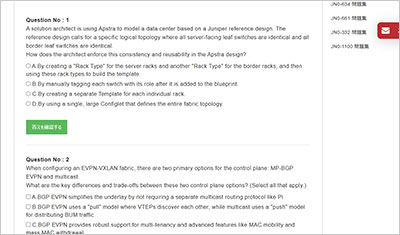
サンプル問題 1: When an agent installation is successful, devices are placed into which state using the Juniper Apstra Ul?
A: IS-MAINT
B: OOS-READY
C: OOS-QUARANTINED
D: IS-ACTIVE
正解:B
Explanation: When an agent installation is successful, devices are placed into the Out of Service Quarantined (OOS-QUARANTINED) state using the Juniper Apstra UI. This state means that the device is not yet managed by Apstra and has not been assigned to any blueprint. The device configuration at this point is called Pristine Config. To make the device ready for use in a blueprint, you need toacknowledge the device, which changes its state to Out of Service Ready (OOS-READY)12. References: - Managing Devices - AOS Device Configuration Lifecycle
サンプル問題 2: Which statement is correct about the Juniper Apstra Rendered configuration?
A: It is built at commit time and stored in a MySQL database.
B: It is stored in a NoSQL database and incrementally updated.
C: It is dynamically tendered at commit time.
D: It is rendered from the graph database and stored locally.
正解:C
サンプル問題 3: Which two statements about VXLAN VNIs are correct? (Choose two.)
A: VNIs can have over 16 million unique values.
B: VNIs identify a collision domain.
C: VNIs identify a broadcast domain
D: VNIs are alphanumeric values.
正解:A, C
Explanation: VXLAN VNIs are virtual network identifiers that are used to identify and isolate Layer 2 segments in the overlay network. VXLAN VNIs have the following characteristics: - VNIs can have over 16 million unique values. This is because VXLAN VNIs are 24-bit fields that can range from 4096 to 16777214, according to the VXLAN standard1. This allows VXLAN to support a large number of Layer 2 segments and tenants in the network. - VNIs identify a broadcast domain. This is because VXLAN VNIs are used to group the end hosts that belong to the same Layer 2 segment and can communicate with each other using VXLAN tunnels. The VXLAN tunnels are established using the VTEP information that is distributed by EVPN. The VTEPs are VXLAN tunnel endpoints that perform the VXLAN encapsulation and decapsulation. The VXLAN tunnels preserve the Layer 2 semantics and support the broadcast, unknown unicast, and multicast traffic within the same VNI2. The following two statements are incorrect in this scenario: - VNIs identify a collision domain. This is not true, because VXLAN VNIs do not identify a collision domain, which is a network segment where data packets can collide with each other. VXLAN VNIs identify a broadcast domain, which is a network segment where broadcast traffic can reach all the devices. Collision domains are not relevant in VXLAN networks, because VXLAN uses MAC-in-UDP encapsulation and IP routing to transport the Layer 2 frames over the Layer 3 network1. - VNIs are alphanumeric values. This is not true, because VXLAN VNIs are numeric values, not alphanumeric values. VXLAN VNIs are 24-bit fields that can range from 4096 to 16777214, according to the VXLAN standard1. Alphanumeric values are values that contain both letters and numbers, such as ABC123 or 1A2B3C. References: - Virtual Extensible LAN (VXLAN) Overview - EVPN LAGs in EVPN-VXLAN Reference Architectures
Juniper JN0-481試験準備をしていますか?それとも自分は全部できそうです。復習する必要がないと思いますか?それとも自分は何もできないような気がします。どうすればいいでしょうか?実は、この問題を解決するのは難しくないです。勉強者がやるべきのは分解分析をマスターすることです。ここではJN0-481問題集を使って学習中の課題を確認し、知識を整理してData Center, Specialist (JNCIS-DC)試験の準備を進めます。
その次に、非常規の試験ポイントのテーマは多すぎてこだわる必要はなくて、重要な試験点のテーマはきっと知識の点をわかります。特にData Center, Specialist (JNCIS-DC)試験は試験資料ポイントが多いです。一つの問題は知識ポイントだけではなく、復習する時はまとめをマスターして、記憶を分類します。知識ポイントが覚えていないか、間違えていないかのために点数をなくしてはいけません。