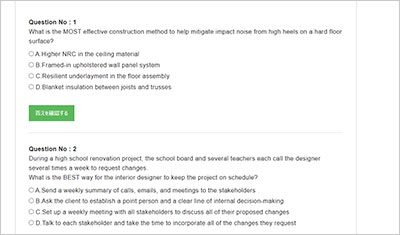
サンプル問題 1: What is the MOST important consideration when specifying light fixtures for a retail store?
A: Wattage
B: Indirect glare
C: Reflected glare
D: Color rendering index
正解:D
Explanation: The NCIDQ IDPX exam tests the designer’s understanding of lighting design, particularly for specific applications like retail stores, where the quality of light significantly impacts the customer experience. Option A (Wattage): Wattage refers to the power consumption of a light fixture, which is important for energy efficiency but is not the most critical factor in a retail store. Modern lighting (e.g., LEDs) focuses more on lumens (light output) than wattage, and wattage does not directly affect the quality of light for retail purposes. Option B (Indirect glare): Indirect glare occurs when light reflects off surfaces in a way that causes discomfort but is not directly in the line of sight. While glare control is important, it is not the most critical factor in retail, where the focus is on product presentation. Option C (Reflected glare): Reflected glare is caused by light bouncing off shiny surfaces (e.g., glass displays) into the viewer’s eyes. While this should be minimized, it is also not the most important consideration compared to how products are perceived. Option D (Color rendering index): This is the correct choice. The Color Rendering Index (CRI) measures how accurately a light source renders colors compared to a reference light (e.g., daylight). In a retail store, the CRI is the most important consideration because it directly affects how products (e.g., clothing, cosmetics) appear to customers. A high CRI (e.g., 80 or above) ensures that colors are true and vibrant, enhancing the shopping experience and influencing purchasing decisions. Verified Answer from Official Source: The correct answer is verified from NCIDQ’s official study materials on lighting design for retail environments. “In retail environments, the most important consideration when specifying light fixtures is the Color Rendering Index (CRI), as it ensures accurate color representation of products, enhancing their appeal to customers.” (NCIDQ IDPX Study Guide, Lighting Design Section) The NCIDQ IDPX Study Guide emphasizes that CRI is the most critical factor in retail lighting because it affects how products are perceived by customers. A high CRI ensures that colors are accurately displayed, which is essential for retail sales, making Option D the correct answer. Objectives: Understand lighting design considerations for retail spaces (NCIDQ IDPX Objective: Lighting Design). Apply lighting specifications to enhance user experience (NCIDQ IDPX Objective: Design Development)
サンプル問題 2: Which space would MOST likely have a dedicated HVAC system?
A: an office in a high rise
B: computer room in a school
C: lobby of a healthcare center
正解:B
Explanation: A computer room (e.g., server room) requires a dedicated HVAC system to maintain precise temperature and humidity control, protecting sensitive equipment from heat and static, per ASHRAE standards. An office in a high rise (A) typically uses a central HVAC system shared across floors. A healthcare lobby (C) relies on general building HVAC, not a dedicated unit, unless critical (e.g., isolation). Computer rooms (B) have unique cooling demands, making a dedicated system most likely. Verified Answer from Official Source: B - computer room in a school "Computer rooms most likely require dedicated HVAC systems to ensure consistent environmental control for equipment performance." (NCIDQ IDPX Study Guide, Section 2: Building Systems) from Official Source: The NCIDQ highlights dedicated HVAC for spaces with specialized needs, like computer rooms, to prevent damage and ensure operational reliability. Objectives: Integrate specialized building systems (IDPX Objective 2.9).
サンプル問題 3: During a final walk-through, the interior designer notices that a decorative light fixture was not installed on a dimmer as specified. Where should the designer document the issue?
A: RFI
B: Change order
C: Punch (deficiency) list
正解:C
Explanation: The NCIDQ IDPX exam tests the designer’s understanding of project closeout procedures, including the documentation of deficiencies during a final walk-through. A final walk-through is conducted to identify any incomplete or incorrect work before the project is considered substantially complete. Option A (RFI): A Request for Information (RFI) is used during construction to seek clarification or additional information from the designer or other parties. It is not the appropriate tool for documenting deficiencies at the end of a project. Option B (Change order): A change order is a formal modification to the construction contract, typically used to address changes in scope, cost, or schedule during construction. The light fixture not being on a dimmer is a deficiency (an error in execution), not a change in scope, so a change order is not appropriate. Option C (Punch (deficiency) list): This is the correct choice. A punch list (also called a deficiency list) is a document created during the final walk-through to record any items that are incomplete, incorrect, or not in accordance with the contract documents. The light fixture not being on a dimmer as specified is a deficiency, and it should be noted on the punch list for the contractor to correct before final completion. Correction of Typographical Error: The original question lists only three options (A, B, C), but the NCIDQ format typically includes four options (A, B, C, D). The missing Option D does not affect the answer, as Option C is clearly the correct choice based on the given options. For completeness, a potential Option D might be something like “Construction schedule,” which would be incorrect, as the schedule is not a tool for documenting deficiencies. Verified Answer from Official Source: The correct answer is verified from NCIDQ’s official study materials on project closeout and punch list procedures. “During a final walk-through, any deficiencies, such as items not installed as specified, should be documented on the punch (deficiency) list for the contractor to address before final completion.” (NCIDQ IDPX Study Guide, Project Closeout Section) The NCIDQ IDPX Study Guide specifies that a punch list is the appropriate tool for documenting deficiencies during a final walk-through. The light fixture issue is a deficiency, and recording it on the punch list ensures it will be corrected, making Option C the correct answer. Objectives: Understand the purpose of a punch list in project closeout (NCIDQ IDPX Objective: Project Closeout). Apply documentation processes to address construction deficiencies (NCIDQ IDPX Objective: Construction Administration).
CIDQ IDPX試験準備をしていますか?それとも自分は全部できそうです。復習する必要がないと思いますか?それとも自分は何もできないような気がします。どうすればいいでしょうか?実は、この問題を解決するのは難しくないです。勉強者がやるべきのは分解分析をマスターすることです。ここではIDPX問題集を使って学習中の課題を確認し、知識を整理してInterior Design Professional Exam試験の準備を進めます。
その次に、非常規の試験ポイントのテーマは多すぎてこだわる必要はなくて、重要な試験点のテーマはきっと知識の点をわかります。特にInterior Design Professional Exam試験は試験資料ポイントが多いです。一つの問題は知識ポイントだけではなく、復習する時はまとめをマスターして、記憶を分類します。知識ポイントが覚えていないか、間違えていないかのために点数をなくしてはいけません。