サンプル問題 1: Most coaching tools and techniques reflect the principles associated with which discipline?
A: Positive psychology
B: Education science
C: Sociology
D: Social work
正解:A
Explanation: The International Coaching Federation (ICF) defines coaching as "partnering with clients in a thought-provoking and creative process that inspires them to maximize their personal and professional potential" (ICF Code of Ethics, Introduction). Many coaching tools and techniques are designed to align with this definition by focusing on strengths, goal-setting, and fostering self-awareness― principles that are deeply rooted in positive psychology. Positive psychology, as a discipline, emphasizes the study and application of strengths, well-being, and optimal human functioning, which directly correlates with the ICF Core Competencies, such as "Facilitates Client Growth" (Competency 8) and "Cultivates Trust and Safety" (Competency 5). For example, tools like the GROW model (Goal, Reality, Options, Will), commonly used in coaching, reflect positive psychology’s focus on forward movement and solutions rather than dwelling on deficits, aligning with ICF’s emphasis on "evoking awareness" (Competency 7). Similarly, techniques such as appreciative inquiry, which encourages clients to explore what works well and build on it, mirror positive psychology’s strengths-based approach and are consistent with ICF’s ethical boundary of empowering clients rather than fixing them (ICF Code of Ethics, Section 2.1). In contrast: B. Education science: While coaching may involve learning, it is not primarily instructional or pedagogical, as education science focuses on structured teaching rather than client-driven discovery. C. Sociology: This discipline studies societal structures and group dynamics, which is broader and less individualized than coaching’s focus on personal potential. D. Social work: Social work often involves advocacy and addressing systemic issues, which exceeds coaching’s boundaries as a non-therapeutic, client-led process (ICF Definition of Coaching). Thus, positive psychology is the discipline most reflected in coaching tools and techniques, as verified by ICF’s foundational principles and competencies
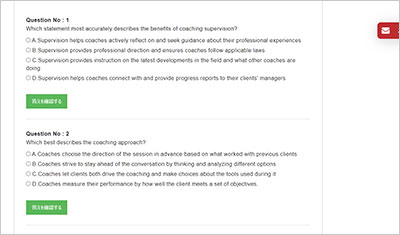
サンプル問題 2: Which sentence best describes the coaching process?
A: Providing wisdom to individuals teams and organizations
B: Supporting change through collaboration and facilitation
C: Improving well-being by working with the client on their issues
D: Creating customized solutions that meet clients' needs
正解:B
Explanation: The ICF defines coaching as a collaborative partnership where the coach facilitates a process to help clients achieve their goals (ICF Definition of Coaching). The sentence "Supporting change through collaboration and facilitation" best captures this essence, aligning with the ICF Core Competencies and ethical guidelines. Specifically: Collaboration: ICF Competency 2 ("Embodies a Coaching Mindset") and Competency 5 ("Cultivates Trust and Safety") emphasize a partnership where the coach and client co-create the process. The ICF Code of Ethics (Section 1.3) reinforces this by requiring coaches to "honor the client’s autonomy," highlighting the collaborative nature of coaching. Facilitation: Competency 7 ("Evokes Awareness") and Competency 8 ("Facilitates Client Growth") describe the coach’s role in guiding clients to insights and actions through questioning and exploration, rather than directing or solving problems for them. This aligns with the ICF’s boundary that coaching is not about providing answers but facilitating client-driven change (ICF Coaching Boundaries). Supporting change: The ultimate aim of coaching, as per ICF, is to inspire and support clients in maximizing their potential, often through transformative shifts in perspective or behavior (ICF Definition of Coaching). Analysis of other options: A. Providing wisdom to individuals, teams, and organizations: This suggests a directive approach, which contradicts ICF’s non-advisory stance (ICF Code of Ethics, Section 2.3: "I will not give my clients advice unless specifically agreed upon"). Coaching is not about imparting wisdom but enabling clients to find their own solutions. C. Improving well-being by working with the client on their issues: While well-being may improve, this phrasing implies a therapeutic focus on "issues," which crosses into counseling and exceeds coaching’s scope (ICF Coaching Boundaries). D. Creating customized solutions that meet clients' needs: Coaches do not "create solutions" for clients; they facilitate clients in discovering their own solutions, per Competency 8 and the ICF ethical principle of client autonomy (ICF Code of Ethics, Section 1). Thus, "Supporting change through collaboration and facilitation" is the most accurate description of the coaching process, as verified by ICF standards.
サンプル問題 3: Which challenge is best addressed through coaching rather than therapy?
A: Inability to concentrate or complete tasks at work over several months
B: Recurring thoughts of self-harm over the past two weeks
C: Feelings of anxiety or panic surrounding work-related tasks
D: Struggling to get promoted despite working at a company for five years
正解:D
Explanation: The ICF defines coaching as a process focused on "partnering with clients in a thought-provoking and creative process that inspires them to maximize their personal and professional potential" (ICF Definition of Coaching). Coaching operates within specific boundaries, emphasizing future-oriented, goal-directed support rather than addressing mental health conditions or deep psychological issues, which fall under therapy (ICF Coaching Boundaries). Let’s analyze each option: A. Inability to concentrate or complete tasks at work over several months: This suggests a persistent cognitive or emotional issue, potentially linked to conditions like ADHD or depression, which require therapeutic intervention beyond coaching’s scope (ICF Code of Ethics, Section 2.5: "I will refer clients to other professionals when appropriate"). B. Recurring thoughts of self-harm over the past two weeks: This is a serious mental health concern requiring immediate therapeutic or psychiatric support, not coaching (ICF Coaching Boundaries explicitly exclude mental health treatment). C. Feelings of anxiety or panic surrounding work-related tasks: While coaching can address performance-related stress, ongoing anxiety or panic suggests a clinical issue better suited for therapy (ICF Code of Ethics, Section 2.5). D. Struggling to get promoted despite working at a company for five years: This is a professional development challenge focused on goals, skills, or strategies―ideal for coaching. It aligns with ICF Competency 8 ("Facilitates Client Growth") by supporting the client in identifying barriers and creating action plans to achieve career aspirations. Thus, option D is best addressed through coaching, as it fits within ICF’s ethical scope and competency framework for enhancing potential without crossing into therapeutic territory.