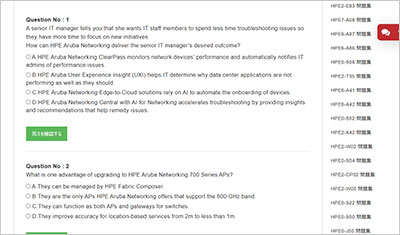
サンプル問題 1: What topic would uncover whether a customer could have a use case for HPE Aruba Networking Zero Trust Security?
A: How much the decision maker understands about how wireless encryption works.
B: How much visibility and control the customer has over users and IoT devices on the network.
C: How IT needs to start focusing its security efforts on perimeter solutions, such as branch and data center firewalls.
D: How IT can improve the user experience for employees using their personal mobile devices.
正解:B
Explanation: The correct answer is B because the foundation of Aruba’s Zero Trust Security strategy isvisibility, control, and continuous monitoring of all users and devices―including IoT―on the network.Aruba highlights that Zero Trust is not achieved simply with perimeter defenses but requires pervasive identity-based controls and segmentation inside the network. Relevant extracts from official HPE Aruba Networking documentation: “Zero Trust begins with full-spectrum visibility of all devices, users, and workloads connecting to the network to ensure nothing is trusted by default.” “With Aruba ClearPass Device Insight and Aruba Central Client Insights, organizations gain the visibility and control required to enforce least-privilege access policies for users and IoT devices.” “The inability to see and control unmanaged IoT devices represents a major security blind spot that Zero Trust frameworks directly address.” “Aruba’s Zero Trust model applies identity-based access and dynamic segmentation to secure all connected endpoints, regardless of location or device type.” Why the other options are incorrect: AWireless encryption knowledge is not a determining factor for Zero Trust adoption―it is too narrow and technical. CPerimeter firewalls are legacy security strategies; Aruba stresses that Zero Trust must focus inside the network, not just at the perimeter. DUser experience on personal devices (BYOD) is relevant but does not directly uncover a Zero Trust use case. The primary driver is IoT and endpoint visibility with policy enforcement. References (HPE Aruba Networking Solutions / Study Guides): Aruba Zero Trust Security ― Solution Overview Aruba ESP (Edge Services Platform) Security White Paper Aruba ClearPass Device Insight ― Technical Guide Aruba Central Client Insights ― Solution Brief
サンプル問題 2: What is a common challenge driving customers to upgrade their networks?
A: The network core and the network edge cannot interoperate with each other.
B: The wireless network cannot deliver the performance users need.
C: The wired network does not support the correct Ethernet technologies for users and IoT devices.
D: Most network vendors only provide command line interfaces for network devices, not easy-to-use GUIs.
正解:B
Explanation: The correct answer is B because one of the most common drivers for network upgrades is that legacy wireless infrastructure cannot meet the growing performance demands of users, IoT devices, and modern applications. With the proliferation of Wi-Fi 6, Wi-Fi 6E, and now Wi-Fi 7, enterprises are upgrading networks to deliver higher capacity, lower latency, and improved user experience. Relevant extracts from HPE Aruba Networking documentation: “Many customers are upgrading to Aruba Wi-Fi 6/6E to address performance gaps created by legacy Wi-Fi networks that cannot meet today’s demand.” “Network modernization is primarily driven by the need for higher wireless throughput, improved efficiency for IoT and mobile devices, and support for cloud-based applications.” “As organizations embrace hybrid work and IoT, wireless networks that fail to deliver required performance have become a leading reason for infrastructure refresh.” “Aruba ESP and Aruba Central enable IT to modernize networks to ensure consistent high-performance wireless experiences.” Why the other options are incorrect: ACore-to-edge interoperability is important, but not the most common driver compared to wireless performance issues. CEthernet technology gaps exist but are secondary compared to wireless upgrade demands. DCLI vs GUI management is a usability concern, but not the primary driver of network refresh projects. References (HPE Aruba Networking Solutions / Study Guides): Aruba ESP Networking Modernization Overview Aruba Wi-Fi 6/6E/7 Upgrade Guide Aruba Edge-to-Cloud Trends and Drivers ― Study Guide Aruba Central for Hybrid Work and IoT ― Technical White Paper
サンプル問題 3: What is one way that an HPE Aruba Networking Central helps to simplify protecting the network?
A: By integrating with HPE Aruba Networking private 5G solutions to automatically enhance the security for Wi-Fi 5, 6, and 7 devices.
B: By providing a “sandbox” environment, in which traffic can be safely inspected for malware.
C: By automatically adding rules to role-based access control policies in response to new types of threats.
D: By providing policy recommendations that admins can quickly preview and apply.
正解:D
Explanation: The correct answer is D because Aruba Central simplifies security by offering policy recommendations through AI-powered insights. These recommendations help IT administrators enforce consistent and adaptive security policies across users, devices, and applications without complex manual configuration. Admins can review the suggested policies and apply them directly, reducing human error and improving security posture. Relevant extracts from HPE Aruba Networking documentation: “Aruba Central leverages AI insights to provide policy recommendations that can be quickly previewed and applied by administrators.” “Policy automation simplifies security operations by reducing the manual overhead associated with access control enforcement.” “With Aruba Central, organizations can streamline role-based access policy deployment, ensuring that best-practice security rules are consistently applied.” “The solution helps IT scale security controls across distributed environments while reducing operational complexity.” Why the other options are incorrect: A. Aruba Central does not rely on private 5G integration for simplifying network protection; that is part of Aruba private 5G solutions. B. Sandboxing traffic inspection is a feature of advanced firewall/security platforms, not Aruba Central. C. Central does not automatically add new access rules without administrator review; instead, it provides recommendations for admins to approve. References (HPE Aruba Networking Solutions / Study Guides): Aruba Central Security and Policy Management ― Solution Guide Aruba ESP Architecture and AI-Powered Security Overview Aruba Central AI Insights and Policy Recommendations ― Technical Brief Aruba Networking Security Simplification Study Guide