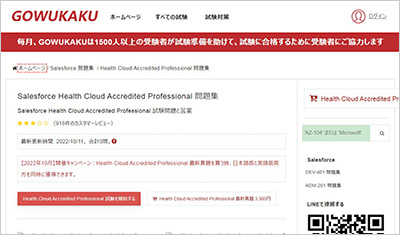
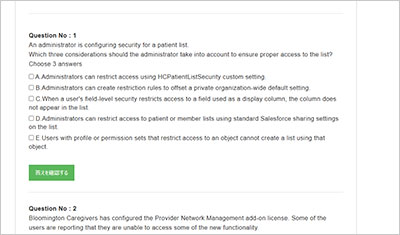
Health Cloud Accredited Professional サンプル問題プレビュー(抜粋)
収録内容から抜粋したサンプル問題です。「解答・解説を表示」をクリックすると正解を確認できます。
サンプル問題 1: Which Health Cloud feature helps ensure compliance with Health Insurance Portability and Accountability Act (HIPAA) regulations?
A: Data visualization and analytics
B: Social media integration
C: User authentication and access control
D: Real-time monitoring and alerts
正解:C
Explanation: Salesforce Health Cloud includes several features to ensure compliance with regulations like the Health Insurance Portability and Accountability Act (HIPAA). Among these, user authentication and access control is a key feature that safeguards protected health information (PHI) by controlling and restricting access based on user roles, permissions, and organizational policies. Why User Authentication and Access Control is Key for HIPAA Compliance: Role-Based Access Control (RBAC): Salesforce allows administrators to define and manage access through role hierarchies and sharing rules. Only authorized users can view, edit, or process sensitive health data. Shield Platform Encryption: Salesforce Shield provides encryption capabilities for PHI. It ensures data remains secure at rest and during transit, an essential requirement of HIPAA. Audit Trails and Field Tracking: Salesforce Health Cloud tracks changes to sensitive data fields, offering detailed logs for auditing purposes. Two-Factor Authentication (2FA): 2FA ensures only authenticated users access the system, adding an extra layer of security to sensitive health information. Compliance Policies: Salesforce’s built-in compliance tools, like health data masking and logging, align with HIPAA requirements. Why Other Options Are Incorrect: A. Data visualization and analytics: While important for decision-making, this feature does not directly address HIPAA compliance as it focuses on operational insights rather than security. B. Social media integration: Social media features are unrelated to HIPAA compliance and could pose risks if improperly managed. D. Real-time monitoring and alerts: While useful for operational efficiency, this feature is not specifically tied to compliance with HIPAA’s privacy and security rules. Reference: Salesforce Security Guide Shield Platform Encryption Guide Administer Health Cloud
サンプル問題 2: A payer is looking to optimize the workflow for its call center, which focuses primarily on members calling to check on the status of their prior authorization requests. How should a consultant conduct discovery to define a workflow for these call center users?
A: Identify personas and ask their to walk through a day in their life, taking notes and identifying opportunities for optimization.
B: Build a proof of concept to present to the client and ask them for feedback.
C: Research Industry trends and develop a point of view, then present it to the customer for validation.
D: Use work from another project to Inform the discovery, then review It with the IT department.
正解:A
Explanation: To optimize workflows for a payer’s call center, conducting a discovery phase requires identifying key pain points, inefficiencies, and opportunities. Identify Personas and Walk Through a Day in Their Life: Engage call center agents and supervisors who handle prior authorization requests and ask them to describe their daily processes, challenges, and tools used. Take detailed notes to map out existing workflows and pinpoint inefficiencies. This approach provides insights into real-world challenges, helping to design tailored workflows that address bottlenecks. Why Other Options Are Incorrect: B. Build a proof of concept to present to the client and ask them for feedback: Building a proof of concept comes later, after completing discovery and requirements gathering. C. Research industry trends and develop a point of view, then present it to the customer for validation: While understanding industry trends is useful, presenting pre-determined workflows without first understanding the customer’s specific needs risks misalignment. D. Use work from another project to inform the discovery, then review it with the IT department: Reusing workflows from another project may not address the unique needs of this customer’s call center processes. Reference: Salesforce Health Cloud Use Case Discovery Best Practices Administer Health Cloud
サンプル問題 3: A consultant is working with an insurance provider to set up prior authorizations in Health Cloud. The provider requires a display of preauthorization outcomes from its external system which manages the end-to-end prior authorization process. Which solution is appropriate to meet this use case?
A: Plan Benefit and Plan Benefit Item
B: Care Preauth and Care Preauth Item
C: Service Preauth and Preauth Detail
D: Care Request and Care Request Item
正解:C
Explanation: In Salesforce Health Cloud, managing prior authorizations involves utilizing specific objects designed to handle the complexities of authorization requests and their associated details. For an insurance provider aiming to display preauthorization outcomes from an external system that manages the end-to-end prior authorization process, the appropriate solution involves the Service Preauth and Preauth Detail objects. Service Preauth Object: Purpose: The Service Preauth object represents a preauthorization request within Health Cloud. It serves as a container for all relevant information pertaining to a specific authorization, including patient details, requested services, and status updates. Integration Capability: This object is designed to integrate with external systems, allowing for the seamless import and display of preauthorization outcomes managed outside of Salesforce. By mapping external authorization data to the Service Preauth object, users can view and manage authorization statuses directly within Health Cloud. Preauth Detail Object: Purpose: The Preauth Detail object stores detailed information related to each preauthorization request captured in the Service Preauth object. This includes specifics about the services or procedures being authorized, such as service codes, descriptions, quantities, and any other pertinent details. Integration Capability: By populating the Preauth Detail object with data from external systems, Health Cloud users gain comprehensive visibility into the components of each authorization request, facilitating informed decision-making and efficient care coordination. Integration Process: To effectively display preauthorization outcomes from an external system within Health Cloud, consider the following steps: Data Mapping: Establish a data mapping strategy to align fields from the external system with the corresponding fields in the Service Preauth and Preauth Detail objects. This ensures that all relevant information is accurately captured and displayed within Health Cloud. Data Import: Utilize Salesforce's data import tools or integration middleware (such as MuleSoft) to import preauthorization data into the Service Preauth and Preauth Detail objects. This process can be automated to ensure real-time or near-real-time updates, providing users with the most current information. User Access and Permissions: Configure user permissions to ensure that appropriate personnel have access to view and manage preauthorization information. This includes setting up profiles and permission sets that grant access to the Service Preauth and Preauth Detail objects. Reference: Authorization Request Overview: This Salesforce Help article provides an overview of managing authorization requests within Health Cloud, detailing the objects and processes involved. Salesforce Built-In MuleSoft Integration to Manage Authorization Requests: This resource outlines how to integrate Health Cloud with external Electronic Health Record (EHR) and payer systems using MuleSoft, facilitating seamless data exchange for authorization requests. Salesforce Care Services Review and Response: This developer guide section discusses RESTful APIs that support data elements required for ANSI X12 278 format Health Care Services Review and Response, enabling electronic receipt of prior authorization requests from providers. Salesforce Developers By leveraging the Service Preauth and Preauth Detail objects, along with appropriate integration strategies, insurance providers can effectively display and manage preauthorization outcomes from external systems within Salesforce Health Cloud, enhancing operational efficiency and improving patient care coordination.
Health Cloud Accredited Professional問題集を使用する正しい方法:間違いがない、または間違えた場合は、マークを付け、エラーの根本原因を見つけて統合し、習熟するまで確認します。
問題演習は、Salesforce Health Cloud試験に向けた現在の理解度を点検するためのステップです。間違えた設問を分析し、なぜ誤ったのかを確認して知識を定着させることが重要です。
Health Cloud Accredited Professional試験に合格するには、主題の知識と試験のルールを習得する必要があります。そして、質問をせずに本を読んでビデオを見るだけでは、明らかに後者のことはできません。慎重に考えて要約することによってのみ、質問のルールを習得し、半分の労力で2倍の結果を得ることができます。
Health Cloud Accredited Professional問題集レビューを使用するメリット
Health Cloud Accredited Professional問題集を使用して、より多くの試験の質問を行うことで研究の問題を見つけてください。そうすれば、より良くなることができます。
Health Cloud Accredited Professional試験の質問に関係することは当然可能です。繰り返しテストされる質問は、頻繁にテストされる質問です。質問に表示されないものは、テストされる可能性が最も低いものです。何度も何度もテストを受ける人は、当然、それを習得するために多くの時間とエネルギーを費やす必要があり、テストをあまり受けない人は、勉強する時間があるまで待つことができます。