サンプル問題 1: An insurance company develops an artificial intelligence (Al) system to manage claims automatically. Although this technology benefits most customers, people from neighborhoods associated with a low socioeconomic status find it harder to get their claims approved. The company decides to keep using the system. Which ethical theory justifies the company to come to this decision?
A: Pluralism
B: Utilitarianism
C: Virtue ethics
D: Deontology
正解:B
Explanation: The decision made by the insurance company aligns with utilitarianism, an ethical theory that evaluates actions based on their overall consequences and aims to maximize happiness or well-being for the greatest number of people. Why Utilitarianism? The company continues using the AI system because it benefits the majority of customers, even though it negatively affects a marginalized group. Utilitarianism, as defined by Jeremy Bentham and later refined by John Stuart Mill, prioritizes actions that generate the most favorable outcomes for the largest number of individuals. Since the AI system increases efficiency and improves claim processing for most customers, the company may justify its use under "the greatest happiness principle." However, utilitarianism can be criticized for neglecting minority groups if their suffering is outweighed by the benefits to the majority, as seen in this case. Why Not the Other Theories? A. Pluralism: Pluralism acknowledges multiple moral values but does not necessarily justify sacrificing fairness for efficiency. The company’s decision does not reflect a commitment to balancing competing moral principles. C. Virtue Ethics: Virtue ethics, based on Aristotle’s philosophy, emphasizes moral character and virtues such as justice and fairness. A company operating under virtue ethics would likely strive to ensure fairness for all customers rather than prioritizing overall utility. D. Deontology: Deontology, rooted in Immanuel Kant's philosophy, focuses on duty, rights, and moral rules. A deontologist would argue that it is unethical to use a system that discriminates against certain groups, even if it benefits the majority. Thus, the correct ethical framework that justifies the company's decision is utilitarianism because it prioritizes the greater good, even at the expense of fairness for a smaller group. Reference in Ethics in Technology: Mill, J. S. (1863). Utilitarianism. London: Parker, Son, and Bourn. Bentham, J. (1789). An Introduction to the Principles of Morals and Legislation. Oxford: Clarendon Press. Floridi, L. (2013). The Ethics of Information. Oxford University Press. Binns, R. (2018). "Fairness in Machine Learning: Lessons from Political Philosophy." Proceedings of the 2018 Conference on Fairness, Accountability, and Transparency (FAT)
サンプル問題 2: An organization decides to provide its employees with additional parental leave benefits that exceed legal requirements. Which concept is the organization acting on to support employees?
A: Ethics code
B: Corporate social responsibility
C: Supply chain sustainability
D: Integrity
正解:B
Explanation: Corporate Social Responsibility (CSR) refers to the ethical obligation of organizations to go beyond legal requirements in improving societal and employee well-being. In this scenario, the organization is voluntarily offering additional parental leave benefits, which demonstrates a commitment to the welfare of its employees beyond what is legally mandated. CSR involves initiatives that benefit various stakeholders, including employees, customers, communities, and the environment. By offering enhanced parental leave benefits, the organization acknowledges its responsibility to promote work-life balance, employee satisfaction, and overall social welfare, which are key principles of CSR. Relevant Ethical Reference in Technology: Utilitarianism (Greatest Good Principle) C Providing extended parental leave benefits leads to greater well-being for employees and their families, fostering a more positive and productive workforce. Deontological Ethics (Duty-Based Ethics) C The company recognizes its ethical duty to care for employees beyond legal obligations, emphasizing moral responsibility rather than mere compliance. Virtue Ethics (Moral Character of the Organization) C The decision reflects virtues such as empathy, fairness, and social responsibility, reinforcing an ethical corporate culture. Corporate Social Responsibility Frameworks C Organizations like the United Nations Global Compact (UNGC) and ISO 26000 emphasize the importance of CSR in areas such as labor practices, human rights, and community involvement. By integrating CSR principles into employee benefits, the organization fosters a more ethical and socially responsible business environment.
サンプル問題 3: A new IT employee has questions about how the organization determines resolutions to issues that impact its values and overarching principles. What should the employee refer to first for guidance?
A: Corporate responsibility matrix
B: Ethical decision-making processes
C: Code of ethics
D: Board of directors
正解:C
Explanation: A Code of Ethics is a formal document that outlines an organization’s values, principles, and expected ethical behaviors. It serves as the first point of reference for employees seeking guidance on ethical decision-making within a company. Why Code of Ethics? The Code of Ethics establishes the foundational principles that guide an organization's decision-making, ensuring consistency in ethical practices. It typically includes guidelines on conflicts of interest, integrity, fairness, and responsibility, helping employees resolve ethical dilemmas. The new IT employee can refer to this document to understand how the company resolves ethical issues and enforces its values. Why Not the Other Options? A. Corporate Responsibility Matrix: This tool may help outline social and environmental responsibilities but does not explicitly guide ethical decision-making. B. Ethical Decision-Making Processes: While important, this is a procedural framework rather than a reference document employees would check first. D. Board of Directors: The Board oversees corporate governance but is not a direct source for employee guidance on ethical matters. Thus, the best answer is C. Code of Ethics as it directly provides ethical standards employees should follow. Reference in Ethics in Technology: Moor, J. (1985). "What is Computer Ethics?" Metaphilosophy, 16(4), 266-275. Floridi, L. (2010). Information: A Very Short Introduction. Oxford University Press. Association for Computing Machinery (ACM) Code of Ethics (2022). IEEE Code of Ethics (2020).
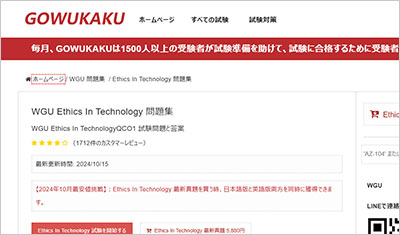
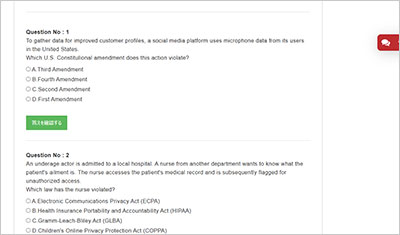
WGU Ethics In Technology試験の準備に向けた復習資料としてEthics In Technology問題集を提供しています。WGU Ethics In TechnologyQCO1試験の主要な知識ポイントをカバーしています。ページ上部の「Ethics In Technology 試験を開始する」ボタンからオンライン無料サンプル問題を確認できます。
Ethics In Technology問題集の収録内容と更新状況はどうなっていますか?
答え:現在提供されているEthics In Technology問題集には、Ethics In Technology試験対策に向けた全66問の練習問題と解答が収録されています。WGU Ethics In TechnologyQCO1試験に向けた復習に利用できます。
答え:時間の許す限り、内容を理解しながら計画的に復習することをお勧めします。Ethics In Technology問題集の多くの設問と知識ポイントを一度の学習ですべて定着させるのは難しいため、3回に分けて反復する方法が効果的です。1回目は全体を通して解説とあわせて理解し、2回目は分野ごとに自分の言葉で説明できるか確認し、3回目は試験直前に間違えやすい設問を中心に総復習します。
学習時間が限られている場合は、Ethics In Technology問題集の選択問題を中心に重要キーワードと正答の根拠を優先して整理してください。また、ドラッグ&ドロップ問題やシミュレーション形式の設問については、手順や前提条件を含めて仕組みを理解しておくことが重要です。