IT認証試験問題集
GOWUKAKU|IT認定資格の最新の試験問題集(PDF版・無料サンプル問題)を提供しています
 ホームページ / ISTQB 問題集  /  CTFL_SYLL_4.0 問題集

ISTQB CTFL_SYLL_4.0 問題集 練習問題・模擬試験|日本語版&英語版対応

ISTQB Certified Tester Foundation Level (CTFL) 試験問題と答案

(0件のカスタマーレビュー)

最終更新日: 2026/10/17  収録内容確認済 | PDF問題集: 全 40 問収録

CTFL_SYLL_4.0試験対策の学習資料(PDF版:日本語・英語2言語セット)|1年間(365日)無料アップデート付
CTFL_SYLL_4.0 試験を開始する   
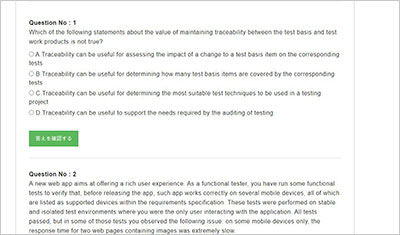
ctfl_syll_4-0_shiken_1
ctfl_syll_4-0_shiken_2

CTFL_SYLL_4.0 問題集 仕様・サポート案内

対象試験 ISTQB CTFL_SYLL_4.0 — ISTQB Certified Tester Foundation Level (CTFL)
収録問題数 全 40 問(解答付き/オンライン無料サンプル 90 問公開中)
提供形式・言語 PDF版(日本語版・英語版の2言語セット)
販売価格(税込) 6,880円(税込) ※1回払いの買い切り商品です。自動更新や追加請求はありません。
引き渡し・有効期間 決済完了後すぐにダウンロード可能(日本語版が準備中の科目は、英語版を即時ダウンロードのうえ、日本語版は準備完了次第ご登録メールへ自動送付・有効化されます)。ご購入日から1年間(365日間)無料アップデート対応(期間内の更新版も追加料金なしでダウンロード可能)。
お問い合わせ窓口 メールサポート:[email protected](注文確認・再送・教材に関するご質問|返金・交換条件)

CTFL_SYLL_4.0 サンプル問題プレビュー(抜粋)

収録内容から抜粋したサンプル問題です。「解答・解説を表示」をクリックすると正解を確認できます。

サンプル問題 1: A virtual service emulating a real third-party service and the automated test scripts (aimed at testing the system under test) that interact with that service, are test work products that are typically created during:

  • A: Test monitoring and control
  • B: Test implementation
  • C: Test design
  • D: Test analysis
正解:B
Explanation: This answer is correct because test implementation is the activity where test work products, such as test cases, test data, test scripts, test harnesses, test stubs, or virtual services, are created and verified. Test implementation also involves setting up the test environment and preparing the test execution schedule. A virtual service emulating a real third-party service and the automated test scripts that interact with that service are examples of test work products that are typically created during test implementation. References: ISTQB Glossary of Testing Terms v4.0, ISTQB Foundation Level Syllabus v4.0, Section 2.2.2.3

サンプル問題 2: Which of the following statements about how different types of test tools support testers is true?

  • A: The support offered by a test data preparation tool is often leveraged by testers to run automated regression test suites
  • B: The support offered by a performance testing tool is often leveraged by testers to run load tests
  • C: The support offered by a bug prediction tool is often used by testers to track the bugs they found
  • D: The support offered by a continuous integration tool is often leveraged by testers to automatically generate test cases from a model
正解:B
Explanation: The support offered by a performance testing tool is often leveraged by testers to run load tests, which are tests that simulate a large number of concurrent users or transactions on the system under test, in order to measure its performance, reliability, and scalability. Performance testing tools can help testers to generate realistic workloads, monitor system behavior, collect and analyze performance metrics, and identify performance bottlenecks. The other statements are false, because: - A test data preparation tool is a tool that helps testers to create, manage, and manipulate test data, which are the inputs and outputs of test cases. Test data preparation tools are not directly related to running automated regression test suites, which are test suites that verify that the system still works as expected after changes or modifications. Regression test suites are usually executed by test execution tools, which are tools that can automatically run test cases and compare actual results with expected results. - A bug prediction tool is a tool that uses machine learning or statistical techniques to predict the likelihood of defects in a software system, based on various factors such as code complexity, code churn, code coverage, code smells, etc. Bug prediction tools are not used by testers to track the bugs they found, which are the actual defects that have been detected and reported during testing. Bugs are usually tracked by defect management tools, which are tools that help testers to record, monitor, analyze, and resolve defects. - A continuous integration tool is a tool that enables the integration of code changes from multiple developers into a shared repository, and the execution of automated builds and tests, in order to ensure the quality and consistency of the software system. Continuous integration tools are not used by testers to automatically generate test cases from a model, which are test cases that are derived from a representation of the system under test, such as a state diagram, a decision table, a use case, etc. Test cases can be automatically generated by test design tools, which are tools that support the implementation and maintenance of test cases, based on test design specifications or test models. References: ISTQB Certified Tester Foundation Level (CTFL) v4.0 sources and documents: - ISTQB® Certified Tester Foundation Level Syllabus v4.0, Chapter 3.4.1, Types of Test Tools - ISTQB® Glossary of Testing Terms v4.0, Performance Testing Tool, Test Data Preparation Tool, Bug Prediction Tool, Continuous Integration Tool, Test Execution Tool, Defect Management Tool, Test Design Tool

サンプル問題 3: Which of the following statements about exploratory testing is true?

  • A: Exploratory testing is an experience-based test technique in which testers explore the requirements specification to detect non testable requirements
  • B: When exploratory testing is conducted following a session-based approach, the issues detected by the testers can be documented in session sheets
  • C: Exploratory testing is an experience-based test technique used by testers during informal code reviews to find defects by exploring the source code
  • D: In exploratory testing, testers usually produce scripted tests and establish bidirectional traceability between these tests and the items of the test basis
正解:B
Explanation: Exploratory testing is an experience-based test technique in which testers dynamically design and execute tests based on their knowledge, intuition, and learning of the software system, without following predefined test scripts or test cases. Exploratory testing can be conducted following a session-based approach, which is a structured way of managing and measuring exploratory testing. In a session-based approach, the testers perform uninterrupted test sessions, usually lasting between 60 and 120 minutes, with a specific charter or goal, and document the issues detected, the test coverage achieved, and the time spent in session sheets. Session sheets are records of the test activities, results, and observations during a test session, which can be used for reporting, debriefing, and learning purposes. The other statements are false, because: - Exploratory testing is not a test technique in which testers explore the requirements specification to detect non testable requirements, but rather a test technique in which testers explore the software system to detect functional and non-functional defects, as well as to learn new information, risks, or opportunities. Non testable requirements are requirements that are ambiguous, incomplete, inconsistent, or not verifiable, which can affect the quality and effectiveness of the testing process. Non testable requirements can be detected by applying static testing techniques, such as reviews or inspections, to the requirements specification, before the software system is developed or tested. - Exploratory testing is not a test technique used by testers during informal code reviews to find defects by exploring the source code, but rather a test technique used by testers during dynamic testing to find defects by exploring the behavior and performance of the software system, without examining the source code. Informal code reviews are static testing techniques, in which the source code is analyzed by one or more reviewers, without following a formal process or using a checklist, to identify defects, violations, or improvements. Informal code reviews are usually performed by developers or peers, not by testers. - In exploratory testing, testers usually do not produce scripted tests and establish bidirectional traceability between these tests and the items of the test basis, but rather produce unscripted tests and adapt them based on the feedback and the findings of the testing process. Scripted tests are tests that are designed and documented in advance, with predefined inputs, outputs, and expected results, and are executed according to a test plan or a test procedure. Bidirectional traceability is the ability to trace both forward and backward the relationships between the items of the test basis, such as the requirements, the design, therisks, etc., and the test artifacts, such as the test cases, the test results, the defects, etc. Scripted tests and bidirectional traceability are usually associated with more formal and structured testing approaches, such as specification-based or structure-based test techniques, not with exploratory testing. References: ISTQB Certified Tester Foundation Level (CTFL) v4.0 sources and documents: - ISTQB® Certified Tester Foundation Level Syllabus v4.0, Chapter 2.2.3, Experience-based Test Design Techniques1 - ISTQB® Glossary of Testing Terms v4.0, Exploratory Testing, Session-based Testing, Session Sheet, Non Testable Requirement, Static Testing, Informal Review, Dynamic Testing, Scripted Testing, Bidirectional Traceability2

ISTQB CTFL_SYLL_4.0試験準備をしていますか?それとも自分は全部できそうです。復習する必要がないと思いますか?それとも自分は何もできないような気がします。どうすればいいでしょうか?実は、この問題を解決するのは難しくないです。勉強者がやるべきのは分解分析をマスターすることです。ここではCTFL_SYLL_4.0問題集を使って学習中の課題を確認し、知識を整理してISTQB Certified Tester Foundation Level (CTFL)試験の準備を進めます。

CTFL_SYLL_4.0問題集を利用して学習中の問題を探し出す。

ISTQB CTFL_SYLL_4.0試験のすべての試験資料ポイントを勉強した後、CTFL_SYLL_4.0問題集の中の問題点を練習してみてください。重要な試験点はどこにあるか、つまりISTQBが把握してほしいものは何ですか?そして練習中の問題点を整理して分析してください。できない問題に対して、正しい答えの考えをはっきりさせたいです。それに関する知識点を明らかにします。間違った問題に対しては、具体的に自分がどこで間違っているかを見に行きます。このステップで使う試験資料ポイントは何ですか?間違った問題をこのように一歩分解して分析すると、自然に自分の復習する方向を見つけます。

その次に、非常規の試験ポイントのテーマは多すぎてこだわる必要はなくて、重要な試験点のテーマはきっと知識の点をわかります。特にISTQB Certified Tester Foundation Level (CTFL)試験は試験資料ポイントが多いです。一つの問題は知識ポイントだけではなく、復習する時はまとめをマスターして、記憶を分類します。知識ポイントが覚えていないか、間違えていないかのために点数をなくしてはいけません。

CTFL_SYLL_4.0問題集を使って復習の効率を高めます。

CTFL_SYLL_4.0問題集を使って出題範囲に沿った練習問題に取り組み、自身の弱点を洗い出したうえで重点分野に絞った学習を強化します。確かに多くの復習方法の中で極めて有効な方法ですが、時間がかかります。実際の生活の中で私達の時間はいつも自分で支配しません。短い時間で復習の効率と質を向上させるには、毎回の復習に新しいものが必要です。どうやってできますか?

具体的な実践の方式は、CTFL_SYLL_4.0問題集のテーマを練習する時、まずテーマの題形を判断して、考察の知識点は同じタイプであれば、頭の中で一回だけ問題を解いたことがあります。見たことのない問題型については、一度真剣にやってみて、問題解決の構想と知識点を全力で理解して覚えてください。次の同じ問題型が現れたら、もう一度問題を解いたら、次の問題に直接飛び込むことができます。このようにジャンプして、モードの解答戦術を選んで、短い時間の内にCTFL_SYLL_4.0試験の覆うすべての知識ポイントのテーマをすべて一回通すことができます。それから、二回目、三回目はだんだん速くなります。正解率はますます高くなります。確かに、長い間勉強し続けていると、自分に嫌な気持ちになりやすいです。

この時、弊社はCTFL_SYLL_4.0問題集をいくつかの部分に分けて、一部分に時間を限定します。例えば、一時間でこれらの本を読み終わったり、8時までにこの章を完成したりします。これは復習の効率を高めるだけではなく、疲労感も生まれません。何度も頑張ってから、だんだん時間を短縮します。そのうち、一時間では終わらないことが分かります。今は四十分で完成します。上記のクイッククイズ方法に合わせて、CTFL_SYLL_4.0試験の内容を一週間でちゃんと復習ができます。

アップデートおよび返金ポリシーについて

ご購入日から1年間(365日間)は、CTFL_SYLL_4.0問題集の更新版を追加料金なしでダウンロードできます。返金の条件は返金ポリシーに従います。

コメントを残す

採点