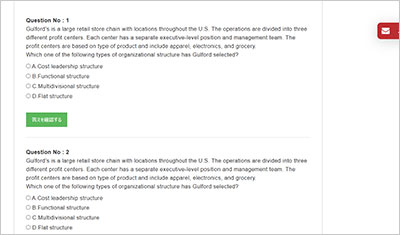
サンプル問題 1: The Growers Insurance Company has begun a SWOT analysis because it has failed to meet its loss ratio goals for three consecutive years. Growers has various strategies in place that have proven successful in the past. Which of the following would be considered a strength that Growers might be able to capitalize on to address its problem?
A: Competition is continuing to drive insurance rates down.
B: Growers’ underwriting staff is very experienced.
C: Growers’ surplus is adequate for the present.
D: Various markets have been identified for growth.
正解:B
Explanation: In CPCU 500, SWOT is used as a strategic decision-making tool to clarify what an organization can control versus what it must respond to. The key rule is that Strengths and Weaknesses are internal (resources, capabilities, culture, processes), while Opportunities and Threats are external (market conditions, competitors, regulation, economic forces). Because Growers is trying to correct an unfavorable loss ratio, the best “strength” should be an internal capability that can directly improve underwriting performance. Option B fits this definition. An experienced underwriting staff is an internal, controllable capability that can be leveraged to improve results through better risk selection, stronger pricing judgment, tighter terms and conditions, improved portfolio management, and more effective corrective action (for example, identifying segments driving loss experience and applying targeted underwriting changes). These actions are directly connected to managing frequency/severity and restoring underwriting profitability. By contrast, option A is an external market force driven by competitors and is typically a threat because it pressures pricing downward. Option D describes a potential external opportunity (growth markets) rather than an internal strength. Option C is internal, but “adequate surplus” is more of a financial condition than a distinctive capability―and it does not directly address the underwriting drivers causing loss ratio deterioration as strongly as underwriting expertise does
サンプル問題 2: An individual who purchases an apartment building to rent to tenants faces both pure risk and speculative risk. Which one of the following is a pure risk?
A: The building may be damaged by a fire.
B: The rental income may not cover expenses.
C: The market value of the building may change.
D: The interest rate on the mortgage may increase.
正解:A
Explanation: CPCU 500 distinguishes pure risk from speculative risk to clarify which uncertainties are generally insurable. A pure risk involves the possibility of loss or no loss, with no opportunity for gain. In contrast, a speculative risk includes the possibility of loss, no loss, or gain and is commonly tied to financial or market outcomes. Option A describes property damage from fire, which is a classic pure risk exposure. A fire can cause a loss, or it may not occur at all, but it cannot create a profit. Because the outcome is limited to loss or no loss and can be evaluated using loss frequency and severity concepts, it fits the type of exposure that insurers are designed to pool and finance through property coverage. The other options describe speculative risks. If rental income does not cover expenses, that reflects business performance and operational results that can vary with occupancy, competition, and management decisions. Changes in market value are driven by broader economic and real estate market forces and can move up or down, creating gain or loss. Mortgage interest rate increases are also market-driven financial uncertainty that may raise costs, but rates could also stay the same or decrease depending on loan terms and economic conditions. These uncertainties involve potential upside or are fundamentally financial market risks, so they are not categorized as pure risk in CPCU 500.
サンプル問題 3: Bobbie works for Triple Hills Associates and is gathering current information to consider the application of a new account. She asks Reggie, a junior underwriter, to gather as much information as he can from public sources about the account to help in her analysis, but to be careful of bias and credibility issues. Which one of the following situations might Reggie avoid reporting to Bobbie due to the informational hazards she mentioned?
A: Reggie discovered offices from the account’s website that are located in an area known for flooding.
B: An online map search of the headquarters revealed they are located in a large corporate building with a number of other companies.
C: Reggie discovered a police report involving one of the account’s truck drivers indicating he did not have a proper CDL license.
D: A former employee posted negative comments about management on a public website.
正解:D
Explanation: CPCU 500 stresses that strong critical thinkers evaluate information quality before using it in decisions. When gathering public-source information, “informational hazards” commonly include bias, lack of verification, missing context, and questionable credibility. The goal is not to ignore all negative information, but to recognize which inputs are most likely to be unreliable or misleading and therefore require careful validation before they influence underwriting judgment. Option D is the best example of a source that presents clear credibility and bias concerns. A former employee’s negative online comments may reflect a personal grievance, selective experiences, or incomplete context. The identity of the poster may be unknown, details may be exaggerated, and claims may not be supported by verifiable facts. CPCU 500 encourages avoiding unsubstantiated or emotionally charged inputs that can distort analysis, or at minimum treating them as preliminary “leads” rather than decision-grade evidence. In contrast, options A and B are generally observable and verifiable (company locations and mapping information), and option C references an official record, which typically carries higher credibility and can be confirmed through appropriate channels. Therefore, the item most likely to be avoided or heavily discounted due to bias and credibility issues is the unverified, potentially biased commentary from a former employee.
試験はこの世界で成功しやすいことの一つです。試験は前もって範囲を教えていますから、復習はこの範囲内の自分ができないところを探し続けています。GOWUKAKUはCPCU-500問題集を用いたCPCU-500(Becoming a Leader in Risk Management and Insurance)試験の復習方法を案内しています。