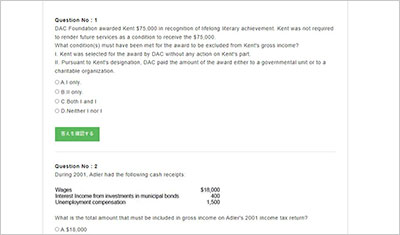
サンプル問題 1: Parker, whose spouse died during the preceding year, has not remarried. Parker maintains a home for a dependent child. What is Parker's most advantageous filing status?
A: Single.
B: Head of household.
C: Married filing separately.
D: Qualifying widow(er) with dependent child.
正解:D
Explanation: Choice "d" is correct. A qualifying widow (er) is a taxpayer who may use the joint tax return standard deduction and rates (but not the exemption for the deceased spouse) for each of two taxable years following the year of death of his or her spouse, unless he or she remarries. The surviving spouse must maintain a household that, for the whole entire taxable year, was the principal place of abode of a son, stepson, daughter, or stepdaughter (whether by blood or adoption). The surviving spouse must also be entitled to a dependency exemption for such individual. Parker may file as a qualifying widow (er) since her spouse died in the previous tax year, she did not remarry and she maintained a home for a dependent child. Since, qualifying widow (er) is the most advantageous status and Parker qualifies, Parker would file as a qualifying widow (er). Choice "a" is incorrect. Even though Parker would qualify as single, filing single would give Parker a high tax liability than the qualifying widow (er) status and therefore is not most advantageous. Choice "b" is incorrect. Parker would not qualify as head of household for the first two years after the death of Parker's spouse because one of the requirements for Head of Household status is that the taxpayer is NOT a surviving spouse. (Also, note that the likely reason for this requirement is that filing as Head of Household status would give the qualifying surviving spouse taxpayer a higher tax liability than the Qualifying Widow(er) status, which would be less advantageous.) Choice "c" is incorrect. Parker would not qualify to file married filing separately
サンプル問題 2: In which of the following situations may taxpayers file as married filing jointly?
A: Taxpayers who were married but lived apart during the year.
B: Taxpayers who were married but lived under a legal separation agreement at the end of the year.
C: Taxpayers who were divorced during the year.
D: Taxpayers who were legally separated but lived together for the entire year.
正解:A
Explanation: RULE: In order to file a joint return, the parties must be MARRIED at the end of the year. Exception: If the parties are married but are LEGALLY SEPARATED under the laws of the state in which they reside, they cannot file a joint return (they will file either under the single or head of household filing status). Choice "a" is correct. Per the above rule, taxpayers who are married but lived apart during the year are allowed to file a joint return for the year. The fact that they did not live together during the year has no bearing on the issue. Choice "b" is incorrect. Per the above rule, taxpayers who are married but lived under a legal separation agreement at the end of the year may not file a joint return. They will generally file either under the single or head of household filing status. Choice "c" is incorrect. Per the above rule, taxpayers who were divorced during the year may not file a joint return together, as they are not married at the end of the year. [Note, however, that they may become married again in the year and file a joint return with the new spouse.] Choice "d" is incorrect. Per the above rule, taxpayers who were legally separated but lived together for the entire year may not file a joint return. They will generally file either under the single or head of household filing status.
サンプル問題 3: Barkley owns a vacation cabin that was rented to unrelated parties for 10 days during the year for $2,500. The cabin was used personally by Barkley for three months and left vacant for the rest of the year. Expenses for the cabin were as follows: Real estate taxes $1,000 Maintenance and utilities $2,000 How much rental income (loss) is included in Barkley's adjusted gross income?
A: $0
B: $500
C: $(500)
D: $(1,500)
正解:A
Explanation: RULE: If a vacation residence is rented for less than 15 days per year, it is treated as a personal residence. The rental income is excluded from income, and mortgage interest (first or second home) and real estate taxes are allowed as itemized deductions. Depreciation, utilities, and repairs are not deductible. Choice "a" is correct. Applying the rule above, if a vacation residence is rented for less than 15 days per year, it is treated as a personal residence. The rental income ($2,500 in this case) is excluded from income. A Schedule E is not filed for this property (i.e., no income is reported, the taxes are reported as itemized deductions, and the maintenance and utilities are not deductible), so the effect on AGI is zero. Choice "b" is incorrect. This assumes that the property taxes are reported as itemized deductions but that the rental income ($2,500) less the maintenance and utilities ($2,000) are reported net on Schedule E. Per the above RULE, the rental income is excluded from income, and the maintenance and utilities are not deductible. Choice "c" is incorrect. This assumes that all of the items shown are reported net on the Schedule E-$2,500 - $1,000 - $2,000 = ($500). Per the above RULE, the rental income is excluded from income, the maintenance and utilities are not deductible, and the property taxes are reported on Schedule A as an itemized deduction. Choice "d" is incorrect, per the above rule and discussion.