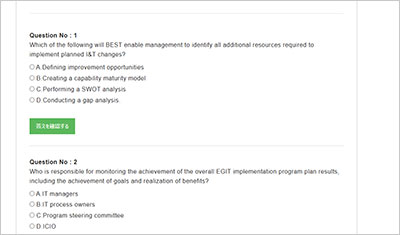
サンプル問題 1: A CEO of a domestic enterprise plans to expand its operations globally. The CEO has selected enterprise goals using the COBIT goals cascade and has tasked the CIO with tailoring COBIT as required. After selecting the relevant alignment goals, which of the following should be the CIOs NEXT priority?
A: Management objectives
B: Design factors
C: Organizational structure
D: Management activities
正解:B
Explanation: In the COBIT 2019 framework, after selecting the relevant alignment goals, the CIO's next priority should be identifying and understanding the design factors. Design factors are crucial as they influence the tailoring of the governance system to align with the specific needs and context of the enterprise. The COBIT 2019 Design Guide emphasizes that design factors impact the governance and management objectives and help in customizing the COBIT framework. The selection and analysis of design factors ensure that the governance system is practical and relevant to the enterprise's environment. Design Factors in COBIT 2019 include: Enterprise Strategy: Different strategies (e.g., growth, innovation, cost leadership) require different governance approaches. Enterprise Goals: Aligning IT-related goals with overall enterprise goals. Risk Profile: Understanding the risk appetite and tolerance. I&T-Related Issues: Identifying issues specific to information and technology. Threat Landscape: Assessing external and internal threats. Compliance Requirements: Meeting legal, regulatory, and contractual obligations. Role of IT: Determining IT's role in the enterprise (e.g., support, factory, turnaround, strategic). Sourcing Model: Whether IT services are in-house, outsourced, or a combination. IT Implementation Methods: Traditional, agile, or hybrid methods used in IT initiatives. Technology Adoption Strategy: How quickly the enterprise adopts new technologies. Enterprise Size: The size of the enterprise can affect governance and management practices. The process of tailoring COBIT involves: Analyzing Design Factors: Understanding and documenting the enterprise's design factors. Designing the Tailored Governance System: Based on the analyzed design factors, select and customize the governance and management objectives. COBIT 2019 Implementation Guide Reference: COBIT 2019 Framework: Introduction and Methodology, Chapter 4. This chapter provides an overview of the COBIT goals cascade and the importance of aligning enterprise goals with IT-related goals. COBIT 2019 Design Guide, Chapter 2. This chapter describes design factors in detail and their role in tailoring the governance system. COBIT 2019 Implementation Guide, Chapter 3. This chapter outlines the steps for implementing a tailored COBIT governance system, emphasizing the importance of understanding and leveraging design factors. Thus, the CIO should prioritize understanding the design factors to ensure the tailored COBIT governance system aligns with the enterprise's specific context and requirements. This approach ensures the governance system is both effective and efficient, addressing the unique challenges and opportunities of the enterprise
サンプル問題 2: Which of the following components should be considered in addition to processes, policies and procedures when designing a governance system?
A: Information items
B: Knowledge flows
C: Data flows
D: Configuration items
正解:A
Explanation: In COBIT 2019, information is seen as a key enabler because it underpins effective governance and management practices. Information items refer to the data and information that the organization needs to achieve its goals and support decision-making processes. This includes various types of information such as financial data, operational data, compliance reports, and performance metrics. The COBIT 2019 Framework identifies seven components of a governance system: Processes: Structured sets of practices and activities to achieve specific objectives and produce a set of outputs in support of achieving overall IT-related goals. Organizational Structures: Key decision-making entities in an enterprise. Principles, Policies, and Frameworks: Established rules and guidelines. Information: All information produced and used by the enterprise, crucial for governance. Culture, Ethics, and Behavior: Encompasses the values of the enterprise and its employees. People, Skills, and Competencies: Required for successful completion of all activities and decision-making. Services, Infrastructure, and Applications: Enabling and supporting the enterprise through its use of technology. Information items fall under the fourth component, "Information," which is necessary for effective governance. Information items ensure that: Decision-makers have the relevant data to make informed decisions. There is transparency and accountability in reporting. The organization can monitor and measure performance against strategic objectives. Compliance with regulatory and legal requirements is maintained. COBIT 2019 Design and Implementation Guide Reference: COBIT 2019 Framework: Introduction and Methodology, Chapter 5: This chapter details the governance and management objectives and their components, highlighting the importance of information. COBIT 2019 Design Guide, Chapter 2: This chapter provides a comprehensive overview of the components of a governance system, including information items. COBIT 2019 Implementation Guide, Chapter 3: This chapter explains how to incorporate various governance system components, such as information items, into the tailored governance system design. Considering information items is essential because they provide the necessary context and insights for effective governance. By ensuring that information is accurate, timely, and relevant, an organization can better align its IT governance with its overall business objectives, thereby enhancing decision-making, performance tracking, and compliance.
サンプル問題 3: When is it MOST important for an enterprise to apply the full governance design workflow and carefully consider all design factors?
A: When the enterprise requires a broad, holistic, and comprehensive view of its governance system
B: When key stakeholders cannot agree on governance objectives, strategy, and priorities
C: When the enterprise needs to focus on one key initiative requiring a major investment
D: When the enterprise must meet complex regulatory requirements for which the enterprise is not currently in compliance
正解:A
Explanation: Applying the full governance design workflow and carefully considering all design factors is most important when an enterprise requires a broad, holistic, and comprehensive view of its governance system. This scenario is where the entire spectrum of the governance framework needs to be analyzed and tailored to ensure it meets the enterprise's overall strategic goals and operational needs. Reference in COBIT 2019 Design and Implementation: COBIT 2019 Design Guide, Chapter 2: This chapter elaborates on how design factors influence the creation of a tailored governance system that is comprehensive and aligns with the enterprise's unique context. COBIT 2019 Framework: Introduction and Methodology, Chapter 4: This chapter discusses the importance of a holistic approach in establishing governance and the necessity of considering all design factors to create a system that encompasses all aspects of enterprise IT and business objectives. COBIT 2019 Implementation Guide, Chapter 3: This chapter provides steps for implementing a comprehensive governance system, emphasizing the importance of a full governance design workflow to achieve a thorough and effective governance structure. By following the full governance design workflow, enterprises can ensure that their governance framework is not only comprehensive but also customized to address specific needs, thereby improving alignment, efficiency, and compliance across the organization.
GOWUKAKUのCOBIT Design and Implementation問題集は、ISACA ISACA COBIT Design and Implementation Certificate認定試験の準備に向けた復習用問題集です。COBIT Design and Implementation問題集を使用して出題形式を確認し、知識の定着度を確認しながら復習を進めることができます。
COBIT Design and Implementation問題集を使用する正しい方法
COBIT Design and Implementation問題集を使用する正しい方法:間違いがない、または間違えた場合は、マークを付け、エラーの根本原因を見つけて統合し、習熟するまで確認します。
問題演習は、COBIT Design and Implementation Certificate試験に向けた現在の理解度を点検するためのステップです。間違えた設問を分析し、なぜ誤ったのかを確認して知識を定着させることが重要です。
COBIT Design and Implementation試験に合格するには、主題の知識と試験のルールを習得する必要があります。そして、質問をせずに本を読んでビデオを見るだけでは、明らかに後者のことはできません。慎重に考えて要約することによってのみ、質問のルールを習得し、半分の労力で2倍の結果を得ることができます。
COBIT Design and Implementation問題集を使用して、より多くの試験の質問を行うことで研究の問題を見つけてください。そうすれば、より良くなることができます。
COBIT Design and Implementation試験の質問に関係することは当然可能です。繰り返しテストされる質問は、頻繁にテストされる質問です。質問に表示されないものは、テストされる可能性が最も低いものです。何度も何度もテストを受ける人は、当然、それを習得するために多くの時間とエネルギーを費やす必要があり、テストをあまり受けない人は、勉強する時間があるまで待つことができます。
ご入金後、マイページからCOBIT Design and Implementation試験問題集の日本語版と英語版の2言語セット(PDF形式)をダウンロードできます。また、試験範囲の改訂や問題集の更新が行われた場合、ご購入日から1年間(365日間)は更新版を追加料金なしでダウンロードできます。返金の条件は返金ポリシーに従います。