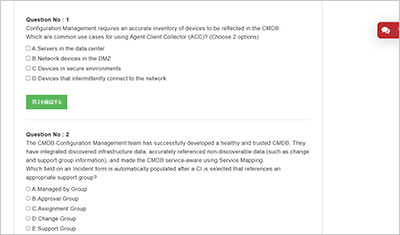
サンプル問題 1: A CMDB Administrator is implementing Vulnerability Response or Security Incident Response and needs to ensure customers have enough context to estimate risk and set task priorities. Which Get Well Playbook from the CSDM Data Foundations Dashboard helps with this?
A: Locations without a Parent Location
B: Application Services with Business Application Relationships
C: Named Product Models without Product Owners
D: Percentage of Custom Status Values for CI Life Cycle Stages
正解:B
Explanation: Comprehensive and Detailed Explanation (200C300 words): In ServiceNow, Vulnerability Response and Security Incident Response rely heavily on business context to accurately assess risk, prioritize remediation tasks, and communicate impact to stakeholders. From a CSDM (Common Service Data Model) perspective, this context is primarily delivered through properly modeled relationships between Application Services and Business Applications. The “Application Services with Business Application Relationships” Get Well Playbook directly addresses this requirement. In CSDM, Application Services represent the technical, deployable services that run in the environment, while Business Applications represent the logical applications that support business capabilities. When these two are correctly related, security teams can clearly understand which business processes, customers, and revenue streams are affected by a vulnerability or security incident. Without this relationship, vulnerabilities may still be detected, but they lack meaningful prioritization. For example, a critical vulnerability on an application service supporting a revenue-generating or customer-facing business application should be addressed far more urgently than one tied to a low-impact internal tool. This relationship is what enables risk-based prioritization, rather than purely technical severity-based prioritization. The other options do not fulfill this need. Location hierarchy issues (Option A) and CI lifecycle status consistency (Option D) relate more to CMDB hygiene and governance, not security context. Product ownership gaps (Option C) affect accountability but do not directly enable risk estimation during security response. Therefore, Option B is the correct and CSDM-aligned Get Well Playbook for ensuring sufficient business context in Vulnerability Response and Security Incident Response workflows
サンプル問題 2: A customer’s CMDB is aligned to the CSDM Walk stage. What benefit is provided by the CMDB?
A: Allows for additional stratification of technical teams’ support structure along the lines of OLAs and commitments
B: Improves the implementation velocity of APM Foundation for future business application rationalization
C: Enables impact assessments for incident, problem, and change on Business Services
正解:C
Explanation: Comprehensive and Detailed Explanation (200C300 words): In the CSDM Walk stage, an organization has moved beyond basic data hygiene (Crawl) and has established foundational service models, especially Business Services and their relationships to underlying technical components. One of the most important and immediate benefits of reaching this stage is the ability to perform reliable impact analysis across ITSM processes. When Business Services are correctly defined and related to Application Services, applications, and infrastructure CIs, the CMDB becomes a decision-support system rather than just a data repository. This enables impact assessments for Incident, Problem, and Change Management, which is exactly what Option C describes. For example, when an incident is logged against a CI, ServiceNow can automatically determine which Business Services are impacted and who the affected stakeholders are. Similarly, during Change Management, planners can assess downstream risk by identifying which business-facing services could be disrupted. Option A is more aligned with advanced operational governance and support model optimization, which typically appears later as organizations mature toward the Run stage. Option B relates to Application Portfolio Management (APM) acceleration, which benefits more from accurate application ownership and lifecycle data rather than core Walk-stage service modeling. Therefore, the correct and CSDM-aligned benefit at the Walk stage is enabling impact assessments for incident, problem, and change on Business Services, making Option C the verified answer.
サンプル問題 3: A CMDB Administrator needs to import external data into the CMDB. To reduce the risk of creating duplicates and prevent updates from unauthorized sources, it must be ensured that the Identification and Reconciliation Engine (IRE) is not bypassed. What is the recommended method to import data into the CMDB utilizing the Identification and Reconciliation API?
A: IntegrationHub ETL
B: Table API (REST API or SOAP API)
C: Import Sets and Transform Maps
正解:A
Explanation: Comprehensive and Detailed Explanation (200C300 words): In ServiceNow, protecting CMDB data quality during ingestion is a core Data Foundations principle. The Identification and Reconciliation Engine (IRE) is designed to ensure that CI records are uniquely identified, merged correctly, and protected from unauthorized overwrites. Any ingestion method that bypasses IRE introduces a high risk of duplicates and data corruption. IntegrationHub ETL is the recommended method because it is natively designed to work with the Identification and Reconciliation API. When properly configured, IntegrationHub ETL ensures that incoming data is processed through IRE, applying identification rules, reconciliation rules, and source precedence. This allows multiple data sources to coexist safely while maintaining CMDB integrity. Option B (Table API) is explicitly discouraged for CMDB ingestion because it writes directly to CMDB tables and bypasses IRE entirely, making it one of the most common causes of duplicate and conflicting CI records. While REST and SOAP APIs are powerful, they are not safe for CMDB ingestion unless they explicitly invoke the IRE API, which most generic table integrations do not. Option C (Import Sets and Transform Maps) can be configured to call IRE, but this requires additional scripting and strict governance. Because of this complexity and higher risk of misconfiguration, it is not the recommended approach when safer, purpose-built options exist. Therefore, IntegrationHub ETL is the verified and best-practice answer, making Option A correct.
ServiceNow CIS-DF試験準備をしていますか?それとも自分は全部できそうです。復習する必要がないと思いますか?それとも自分は何もできないような気がします。どうすればいいでしょうか?実は、この問題を解決するのは難しくないです。勉強者がやるべきのは分解分析をマスターすることです。ここではCIS-DF問題集を使って学習中の課題を確認し、知識を整理してCertified Implementation Specialist - Data Foundations (CMDB and CSDM)試験の準備を進めます。
その次に、非常規の試験ポイントのテーマは多すぎてこだわる必要はなくて、重要な試験点のテーマはきっと知識の点をわかります。特にCertified Implementation Specialist - Data Foundations (CMDB and CSDM)試験は試験資料ポイントが多いです。一つの問題は知識ポイントだけではなく、復習する時はまとめをマスターして、記憶を分類します。知識ポイントが覚えていないか、間違えていないかのために点数をなくしてはいけません。