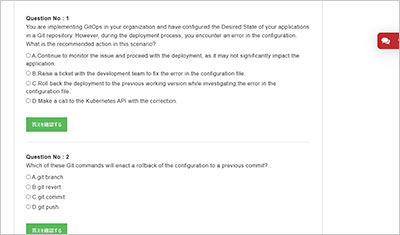
サンプル問題 1: In GitOps practices, when does CD take part?
A: CD takes part simultaneously with CI, both components of GitOps practices.
B: CD takes part after CI to automate the deployment of applications based on changes in the Git repository.
C: CD takes part before CI stage in order to ensure the successful deployment of applications.
D: CI plays a significant role in GitOps practices.
正解:B
Explanation: In GitOps, Continuous Deployment (CD) follows after Continuous Integration (CI). CI is responsible for building and testing application code, while CD automates the delivery and deployment of these changes into runtime environments. The Git repository serves as the single source of truth, and when CI merges new changes into the main branch, CD reconciles the state of the environment to match what is declared in Git. “GitOps builds on the principles of DevOps by using Git as the source of truth for declarative infrastructure and applications. CI pipelines handle the integration and testing of code, and CD pipelines or agents automatically reconcile the desired state in Git with the actual state in the cluster.” This shows that CD is triggered after CI to handle deployment automation, ensuring systems remain in sync with what is declared in version control. Reference: GitOps Principles (CNCF GitOps Working Group), GitOps Working Group Terminology & Principles documents
サンプル問題 2: In the context of GitOps, what happens to a GitOps-managed Kubernetes cluster if there is drift divergence?
A: The GitOps-managed Kubernetes cluster ignores the drift divergence and continues to operate as it is.
B: The GitOps-managed Kubernetes cluster automatically reconciles the drift divergence to return the cluster to the Desired State.
C: The GitOps-managed Kubernetes cluster notifies the administrator about the drift divergence and waits for manual intervention.
D: The GitOps-managed Kubernetes cluster rolls back to the previous known state before the drift divergence occurred.
正解:B
Explanation: A GitOps-managed Kubernetes cluster uses reconciliation loops to continuously compare the actual state of the system with the desired state declared in Git. When drift (divergence between declared configuration and live cluster state) is detected, the GitOps operator automatically reconciles the difference to bring the system back into alignment. “In GitOps, a reconciliation loop ensures that the desired state as declared in Git is continuously compared with the observed state of the system. If drift is detected, the system automatically takes corrective action to reconcile the difference and restore the declared configuration.” This ensures consistency, reliability, and self-healing. Manual intervention is not required for drift correction, as the automated reconciliation is a core principle of GitOps. Reference: GitOps Principles (CNCF GitOps Working Group), GitOps Principles Document ― Principle 4: Software agents automatically pull the desired state declarations from the source and continuously observe actual system state, reconciling differences.
サンプル問題 3: In GitOps, what does the principle of Versioned and Immutable mean?
A: All changes to configuration and infrastructure should be made directly on production environments.
B: All software versions should be stored in a Git repository.
C: Configuration and infrastructure code should be version-controlled and treated as immutable artifacts.
D: Configuration and infrastructure code should be modified directly on production environments.
正解:C
Explanation: One of the four fundamental GitOps principles is Versioned and Immutable. This means that the entire system’s desired state must be stored in a Git repository with version control. Each change must be represented as a commit, and Git’s immutability guarantees a reliable, auditable history of how the system evolved. “The desired state is stored in a version control system. The record of truth is stored in an immutable history, and changes can be audited and reverted if necessary. This guarantees that the system’s configuration is versioned, immutable, and traceable.” Thus, configuration and infrastructure must be version-controlled and immutable, never changed directly in production. Reference: GitOps Principles (CNCF GitOps Working Group), Principle 2: The desired system state is stored as versioned and immutable.
The Linux Foundation CGOA試験準備をしていますか?それとも自分は全部できそうです。復習する必要がないと思いますか?それとも自分は何もできないような気がします。どうすればいいでしょうか?実は、この問題を解決するのは難しくないです。勉強者がやるべきのは分解分析をマスターすることです。ここではCGOA問題集を使って学習中の課題を確認し、知識を整理してCertified GitOps Associate Exam試験の準備を進めます。
CGOA問題集を利用して学習中の問題を探し出す。
The Linux Foundation CGOA試験のすべての試験資料ポイントを勉強した後、CGOA問題集の中の問題点を練習してみてください。重要な試験点はどこにあるか、つまりThe Linux Foundationが把握してほしいものは何ですか?そして練習中の問題点を整理して分析してください。できない問題に対して、正しい答えの考えをはっきりさせたいです。それに関する知識点を明らかにします。間違った問題に対しては、具体的に自分がどこで間違っているかを見に行きます。このステップで使う試験資料ポイントは何ですか?間違った問題をこのように一歩分解して分析すると、自然に自分の復習する方向を見つけます。