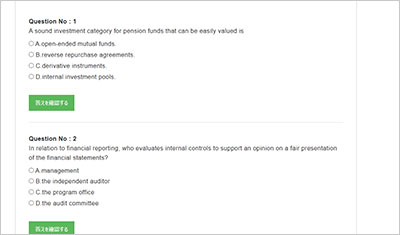
サンプル問題 1: A city decides to invest in a new piece of equipment and wants to know how long it will take to recover the amount invested by using the payback analysis technique. The city uses the following assumptions in its analysis: The cost of the equipment is $500,000. The equipment will generate $200,000 in revenue per year. The variable costs of operating the equipment will be $100,000 per year. The depreciation on the equipment will be $20,000 per year. How long will it take the city to recover the amount invested in the new equipment?
A: 2 years and 6 months
B: 2 years and 9 months
C: Syears
D: 6 years and 3 months
正解:C
サンプル問題 2: In an internal control evaluation, what are the roles of management and the auditor regarding the risk of fraud, waste and abuse?
A: Management identifies risks, auditors assess control effectiveness.
B: Auditors identify risks, management implements control measures.
C: Both management and auditors determine risk tolerance levels.
D: Management mitigates risks, auditors monitor compliance with controls.
正解:A
Explanation: Role of Management in Internal Control Evaluation: Responsibility for Risk Identification: Management has the primary responsibility for designing, implementing, and maintaining an effective system of internal controls. As part of this process, management identifies the risks related to fraud, waste, and abuse that could impact financial reporting or operational efficiency. Mitigating Risks: Once risks are identified, management is responsible for mitigating them by developing appropriate policies, procedures, and controls. Role of the Auditor in Internal Control Evaluation: Assessing Control Effectiveness: Auditors are not responsible for designing or implementing controls; rather, their role is to evaluate whether the controls put in place by management are effective. They do this through testing, observation, and other audit procedures. Fraud Risk Assessment: As part of their duties under Generally Accepted Government Auditing Standards (GAGAS), auditors must assess the risk of material misstatement due to fraud and evaluate how management’s controls address those risks. Why Other Options Are Incorrect: B. Auditors do not identify risks―this is management's job. Auditors evaluate and assess the controls already in place. C. Determining risk tolerance is a governance and management responsibility, not the joint responsibility of auditors and management. D. Management mitigates risks, but auditors don’t monitor compliance with controls―they test and evaluate the controls as part of their audit procedures. Reference and Documents: GAGAS (Yellow Book) by GAO: Emphasizes management’s responsibility for risk identification and the auditor’s responsibility for assessing control effectiveness. COSO Internal Control Framework (2013): Highlights management’s responsibility for risk assessment and control design, while auditors provide independent assurance.
サンプル問題 3: The Federal Credit Reform Act of 1990 prescribes a special budget treatment for direct loans and loan guarantees that measures cash flows to and from the government using which financial analytical technique?
A: future value
B: net present value
C: current value
D: regression analysis
正解:B
Explanation: Federal Credit Reform Act of 1990: This Act established a new accounting framework for federal credit programs, such as direct loans and loan guarantees. It requires using the net present value (NPV) method to measure the costs of loans and guarantees by discounting future cash flows (e.g., loan repayments, defaults) to their present value. Explanation of Financial Analytical Technique: Net Present Value (NPV): Accounts for the time value of money by discounting future cash flows to the present. It provides an accurate measure of the economic cost to the government. Other options: A. Future value: Focuses on future cash flows, not their present cost. C. Current value: Not a recognized technique for analyzing long-term cash flows. D. Regression analysis: A statistical method, unrelated to calculating loan program costs. Reference: Federal Credit Reform Act of 1990, Section 502. Congressional Budget Office (CBO), Federal Credit Program Cost Analysis. Office of Management and Budget (OMB), Circular A-11: Credit Reform Accounting.
AGA CGFM試験の準備に向けた復習資料としてCGFM問題集を提供しています。CGFM Certified Government Financial Manager試験の主要な知識ポイントをカバーしています。ページ上部の「CGFM 試験を開始する」ボタンからオンライン無料サンプル問題を確認できます。
CGFM問題集の収録内容と更新状況はどうなっていますか?
答え:現在提供されているCGFM問題集には、CGFM試験対策に向けた全115問の練習問題と解答が収録されています。CGFM Certified Government Financial Manager試験に向けた復習に利用できます。