サンプル問題 1: Management has requested a 15-minute battery bank assuming full load on the UPS. The UPS vendor has provided the following specifications of the UPS: • Rated power: 30 kVA • Rectifier input voltage: 400 V/3 phase • Rectifier input power factor: 0.8 • Battery rated voltage: 384 V • Number of cells: 192 • End of discharge voltage: 308 V • Inverter output voltage: 400 V/3 phase • Inverter output power factor: 0.8 What information is missing to perform the battery calculation?
A: UPS efficiency
B: Inverter efficiency
C: Load imbalance on the phases
D: Available battery charging current
正解:A
Explanation: To determine the required capacity of the battery bank for the 15-minute runtime at full load, one must know the total power requirement that the battery bank must supply. The specifications provided include most of the necessary details, such as rated power, input voltage, battery voltage, and discharge voltage. However, one critical piece of information is missing: the UPS efficiency. Detailed Explanation In a data center UPS system, the battery bank is designed to supply power for a set duration when there is an input power failure. The UPS efficiency affects the actual power the UPS can deliver to the load compared to the power it draws from the batteries. The efficiency factor is necessary to accurately calculate the required capacity of the battery bank since it determines how much input power is needed from the batteries to supply the load at full capacity. The formula typically used to determine battery capacity involves factoring in UPS efficiency, as it allows you to understand the losses within the UPS system. If UPS efficiency is not considered, there would be an inaccurate estimation of the actual power needed from the batteries. For instance, if a UPS has 90% efficiency, only 90% of the power drawn from the batteries reaches the load. Without knowing this efficiency, it is not possible to calculate the battery bank size accurately, as you cannot accurately estimate the losses within the UPS itself. EPI Data Center Specialist References: According to EPI Data Center Specialist training, understanding the UPS efficiency is essential for battery sizing. Without it, the calculations could lead to either under sizing or oversizing the battery bank, which affects both reliability and cost-effectiveness of the UPS system. The EPI Data Center Specialist course emphasizes that battery sizing must account for all losses within the UPS system, with efficiency being a primary factor in these calculations
サンプル問題 2: The pipes of a VESDA smoke detection system are installed at the air intake of the air conditioner inside the computer room. Is this a good practice from an early smoke detection point of view?
A: It depends on the type of gas-based fire suppression which will be installed.
B: Yes, as this reduces the amount of piping to be installed in the data center, as all air will go through the air conditioner.
C: No, the piping should be installed at the air exhaust of the air conditioner, as there can also be a fire inside the air conditioner itself.
D: No, it will give a longer reaction time for the smoke detection system and there might also be bypass airflow.
正解:D
Explanation: For optimal early smoke detection in a data center, it is crucial that the Very Early Smoke Detection Apparatus (VESDA) system be installed at locations where smoke will be detected as soon as it appears. Positioning the VESDA pipes at the air intake of the air conditioner inside the computer room is not ideal. This placement could result in a delayed detection response and the potential for bypass airflow to occur, which would impede the system’s ability to detect smoke effectively . Detailed Explanation When VESDA pipes are installed at the air intake, the detection system relies on the smoke to be drawn into the air conditioning unit before detection can occur. This setup increases the reaction time as the smoke has to travel through the intake and get processed by the air conditioner. Furthermore, bypass airflow―a phenomenon where not all the air containing smoke particles passes through the VESDA pipes―could also delay or even prevent the system from detecting smoke early. Ideally, VESDA pipes should be positioned where smoke is likely to accumulate first, such as near the ceiling or in the return airflow path to detect smoke at the earliest possible stage. This ensures that the detection system can quickly trigger alarms, providing more time to address potential fire hazards. EPI Data Center Specialist References: EPI Data Center Specialist training highlights that smoke detection should prioritize early response capabilities to maximize safety. The preferred installation for VESDA pipes is generally at points where smoke would naturally accumulate, rather than relying on air conditioning intakes where airflow can vary and delay detection. In their course materials, EPI emphasizes minimizing reaction time and reducing the impact of airflow dynamics on smoke detection efficiency.
サンプル問題 3: You need to determine the strategy for the cooling audit. All the servers are based on a front-to-rear (F-R) airflow design. Which location for the temperature/humidity measurement should you recommend for the audit?
A: At the back/rear of the server at 50 mm/2 inch
B: At 1.5 meters/5 feet above the floor in the middle of the cold aisle
C: At the front/intake of the server at 50 mm/2 inch
D: At 1.5 meters/5 feet above the floor in the middle of the hot aisle
正解:C
Explanation: For a cooling audit in a data center, it is essential to measure temperature and humidity where air enters the servers to accurately assess cooling performance. In this case, since all servers have a front-to-rear (F-R) airflow design, measuring at the front/intake of the server will provide a precise understanding of the cooling conditions that the equipment is experiencing . Detailed Explanation Servers with a front-to-rear airflow design draw in cool air from the cold aisle at the front, which is then exhausted into the hot aisle at the rear. By measuring temperature and humidity 50 mm/2 inches from the front intake, you gather data on the air conditions right before it enters the servers, providing an accurate representation of the cooling environment as it directly impacts the equipment. Measuring in the cold aisle at the front intake ensures that the readings reflect the actual conditions of the incoming air that the servers depend on for effective cooling. This approach is consistent with best practices for maintaining thermal conditions in a data center, as it helps confirm that the cooling systems are delivering air within the required temperature and humidity specifications. EPI Data Center Specialist References: According to the EPI Data Center Specialist curriculum, the optimal placement for temperature and humidity sensors is at the intake of the equipment in the cold aisle, as it directly correlates to the environmental conditions affecting the servers. This positioning allows for a more effective audit of cooling performance, which is critical for maintaining the reliability and efficiency of the data center’s operations.
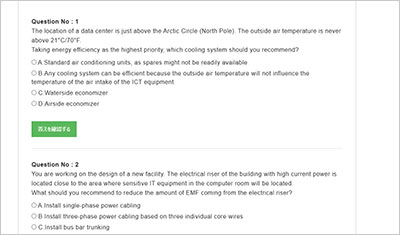
EXIN CDCS試験の準備に向けた復習資料としてCDCS問題集を提供しています。EXIN EPI Certified Data Centre Specialist試験の主要な知識ポイントをカバーしています。ページ上部の「CDCS 試験を開始する」ボタンからオンライン無料サンプル問題を確認できます。
CDCS問題集の収録内容と更新状況はどうなっていますか?
答え:現在提供されているCDCS問題集には、CDCS試験対策に向けた全60問の練習問題と解答が収録されています。EXIN EPI Certified Data Centre Specialist試験に向けた復習に利用できます。