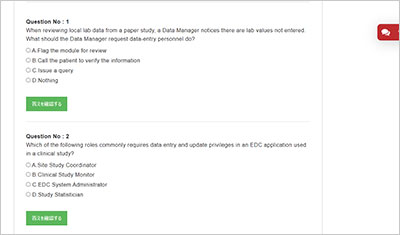
サンプル問題 1: According to the FDA Guidance for Industry, Providing Regulatory Submissions in Electronic Format (April 2006) and Good Clinical Data Management Practices (GCDMP, May 2007), which of the following is the most acceptable for a derived field?
A: Providing CRF annotation "not entered in the database" next to the average score
B: Providing the algorithm for calculating the average score on the CRF
C: Providing the algorithm for calculating the average score in the dataset definition file
D: Providing CRF annotation AVE next to the average score
正解:C
Explanation: In clinical data management, a derived field refers to any variable that is not directly collected from the Case Report Form (CRF) but is instead calculated or inferred from one or more collected variables (for example, calculating an average blood pressure from multiple readings). Proper documentation of derived fields is essential for ensuring data traceability, transparency, and compliance with both FDA and SCDM guidelines. According to the Good Clinical Data Management Practices (GCDMP, May 2007), all derivations and transformations applied to clinical data must be clearly defined and documented in metadata such as the dataset definition file (also referred to as data specifications, variable definition tables, or Define.xml files). The derivation algorithm should be explicitly stated in this documentation to allow independent verification, regulatory review, and reproducibility of results. The FDA Guidance for Industry (April 2006) on electronic submissions further emphasizes that derived fields must be supported by comprehensive metadata that defines the computational method used. This documentation enables the FDA or any regulatory body to audit and reproduce analytical results without ambiguity. Annotating or describing derivations directly on the CRF (as in options A, B, or D) is not sufficient, as CRFs represent data collection instruments―not analytical documentation. Therefore, the correct and regulatory-compliant practice is to provide the derivation algorithm for a calculated field within the dataset definition file, aligning with both FDA and GCDMP expectations for data integrity and auditability. Reference (CCDM-Verified Sources): Society for Clinical Data Management (SCDM), Good Clinical Data Management Practices (GCDMP), Chapter: Data Handling and Processing C Derived and Calculated Data Fields, Section 5.3.3 FDA Guidance for Industry: Providing Regulatory Submissions in Electronic Format, April 2006, Section 3.2 on Dataset Documentation Requirements CDISC Define.xml Implementation Guide C Metadata and Algorithm Documentation for Derived Variables
サンプル問題 2: A study numbers subjects sequentially within each site and does not reuse site numbers. Which information is required when joining data across tables?
A: Subject number and site number
B: Subject number
C: Study number and subject number
D: Site number
正解:A
Explanation: When subjects are numbered sequentially within each site, it means that the subject identification numbers (Subject IDs) restart from 001 at each site. For example, Site 101 may have Subject 001, and Site 102 may also have a Subject 001. In such cases, the subject number alone is not globally unique across the entire study. Therefore, when integrating or joining data across multiple database tables (for example, linking demographic, adverse event, and laboratory data), both the site number and the subject number are required to create a unique key that accurately identifies each record. According to the Good Clinical Data Management Practices (GCDMP, Chapter on CRF Design and Data Collection), every data record in a clinical trial database must be uniquely and unambiguously identified. This is typically achieved through a composite key, combining identifiers such as site number, subject number, and sometimes study number. The GCDMP specifies that a robust data structure must prevent duplication or mislinking of records across domains or tables. Furthermore, FDA and CDISC standards (SDTM model) also emphasize the importance of unique subject identifiers (USUBJID), which are derived from concatenating the study ID, site ID, and subject ID. This ensures traceability, integrity, and accuracy of subject-level data during database joins, data exports, and regulatory submissions. Thus, in the described scenario, since subject numbering restarts at each site, both the site number and subject number are required to uniquely identify and correctly join subject data across different datasets or tables. Reference (CCDM-Verified Sources): SCDM Good Clinical Data Management Practices (GCDMP), Chapter: CRF Design and Data Collection, Section 4.1 C Unique Subject Identification CDISC SDTM Implementation Guide, Section 5.2 C Subject and Site Identification (Variable: USUBJID) FDA Guidance for Industry: Computerized Systems Used in Clinical Investigations, Section 6 C Data Integrity and Record Identification
サンプル問題 3: Which of the following factors can be tested through a second test transfer?
A: Change management
B: File format
C: Transfer method
D: Transfer frequency
正解:B
Explanation: In the context of database design and external data management, a test data transfer (or trial data load) is performed to ensure the proper configuration, structure, and integrity of data imported from an external vendor or system. The second test transfer is specifically useful to confirm that data structures and formats are consistently aligned between the sending and receiving systems after initial adjustments have been made from the first test. According to the Good Clinical Data Management Practices (GCDMP), the file format ― including variables, data types, field lengths, delimiters, and encoding ― must be validated during test transfers to confirm compatibility and ensure accurate loading into the target database. Once the initial test identifies and corrects errors (e.g., mismatched variable names or data types), the second transfer verifies that the corrections have been implemented correctly and that the file structure functions as intended. Testing change management (A) involves procedural controls, not data transfers. The transfer method (C) and transfer frequency (D) are validated during initial process setup, not during subsequent test transfers. Therefore, option B (File format) is correct, as the second test transfer verifies the technical integrity of the file structure before live production transfers begin. Reference (CCDM-Verified Sources): SCDM Good Clinical Data Management Practices (GCDMP), Chapter: External Data Transfers and Data Integration, Section 5.2 C Test Transfers and File Validation FDA Guidance for Industry: Computerized Systems Used in Clinical Investigations, Section 6.3 C Data Import and Validation Controls
SCDM CCDM試験準備をしていますか?それとも自分は全部できそうです。復習する必要がないと思いますか?それとも自分は何もできないような気がします。どうすればいいでしょうか?実は、この問題を解決するのは難しくないです。勉強者がやるべきのは分解分析をマスターすることです。ここではCCDM問題集を使って学習中の課題を確認し、知識を整理してCertified Clinical Data Manager試験の準備を進めます。
その次に、非常規の試験ポイントのテーマは多すぎてこだわる必要はなくて、重要な試験点のテーマはきっと知識の点をわかります。特にCertified Clinical Data Manager試験は試験資料ポイントが多いです。一つの問題は知識ポイントだけではなく、復習する時はまとめをマスターして、記憶を分類します。知識ポイントが覚えていないか、間違えていないかのために点数をなくしてはいけません。