サンプル問題 1: Where do you enable opportunistic cross-docking in a decentralized EWM?
A: In the warehouse and the document type
B: In the product and the warehouse process type
C: In the warehouse and the product
D: In the product and the document type
正解:B
Explanation: Comprehensive and Detailed In-Depth Opportunistic cross-docking in SAP EWM allows goods to be moved directly from goods receipt to goods issue without intermediate storage, optimizing warehouse efficiency. This functionality is enabled at the product level and linked to the warehouse process type, which defines the process flow (e.g., putaway, picking, or cross-docking). In a decentralized EWM system, the configuration is maintained in the product master data (under the "Warehouse" tab) where you specify cross-docking relevance, and in the warehouse process type (SPRO: SCM Extended Warehouse Management > Cross-Docking > Opportunistic Cross-Docking) where the system determines whether a product can bypass putaway. The warehouse process type controls the movement type, and the product master defines eligibility, making option B the correct choice. Options A, C, and D are incorrect because the document type and warehouse alone do not control this process―it's a combination of product-specific settings and process type logic. Reference: SAP S/4HANA Cloud, Private Edition, EWM Configuration Guide - "Cross-Docking Configuration"; SAP Help Portal - "Opportunistic Cross-Docking in EWM."
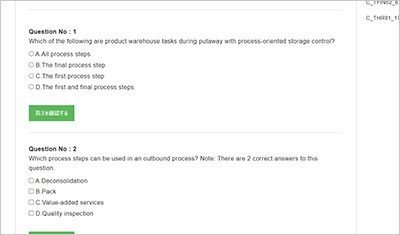
サンプル問題 2: Using embedded EWM, what options do you have for the goods receipt posting for external procurement? Note: There are 2 correct answers to this question.
A: Use synchronous goods receipt where you post the GR in ER
B: Use the ERP Inbound Delivery to post goods receipt.
C: Use the EWM Inbound Delivery to post goods receipt.
D: Use synchronous goods receipt where you post the GR in EW
正解:B
Explanation: Comprehensive and Detailed In-Depth In embedded EWM within SAP S/4HANA Cloud, Private Edition, goods receipt (GR) for external procurement can be posted using two primary methods. Option B ("Use the ERP Inbound Delivery to post goods receipt") is correct because the ERP inbound delivery (created in SAP ERP/S/4HANA MM) serves as the reference document, which is then replicated to EWM for warehouse processing. Option C ("Use the EWM Inbound Delivery to post goods receipt") is also correct because the inbound delivery in EWM, derived from the ERP document, is where the actual GR is confirmed and posted back to ERP via integration. Synchronous GR (options A and D) is not a standard feature in embedded EWM for external procurement, as the process relies on asynchronous communication between ERP and EWM via queued remote function calls (qRFC). The GR posting is finalized in ERP based on EWM confirmation, ensuring inventory alignment. Reference: SAP S/4HANA Cloud, Private Edition, EWM Integration Guide - "Goods Receipt Process for External Procurement"; SAP Help Portal - "Inbound Delivery Processing in Embedded EWM."
サンプル問題 3: What information is used to determine the availability group? Note: There are 3 correct answers to this question.
A: Storage location
B: Stock type role
C: Non-location-dependent stock type
D: Plant
E: Warehouse number
正解:A, D, E
Explanation: Comprehensive and Detailed In-Depth The availability group in SAP EWM defines how stock is grouped for availability checks and is critical for inventory management integration with SAP S/4HANA. It is determined by the plant, storage location, and warehouse number. Option A ("Storage location") is correct because it specifies the physical or logical location within a plant, influencing stock availability. Option D ("Plant") is correct as it’s the organizational unit tying inventory to a specific facility. Option E ("Warehouse number") is correct because it links the availability group to a specific EWM-managed warehouse. Stock type role (B) and non-location-dependent stock type (C) influence stock categorization but are not directly used to define the availability group; they are subordinate to the plant/storage location/warehouse structure. This configuration is maintained in SPRO: SCM Extended Warehouse Management > Goods Receipt Process > Configure Availability Group. Reference: SAP S/4HANA Cloud, Private Edition, EWM Configuration Guide - "Availability Group Settings"; SAP Help Portal - "Stock Management in EWM."
GOWUKAKUのC_S4EWM_2023問題集は、SAP SAP Certified Associate - SAP S/4HANA Cloud Private Edition, Extended Warehouse Management認定試験の準備に向けた復習用問題集です。C_S4EWM_2023問題集を使用して出題形式を確認し、知識の定着度を確認しながら復習を進めることができます。