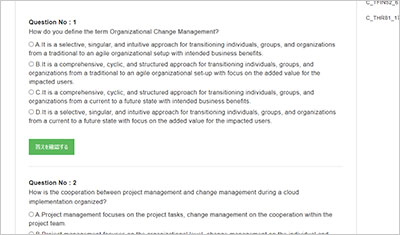
サンプル問題 1: What is the added value of a change plan? Note: There are 2 correct answers to this question.
A: It allows you to coordinate and monitor the progress of all change management activities.
B: It facilitates the ranking of change management activities according to their importance.
C: It provides important input for updating the overall project plan.
D: It helps to identify required resources for the change management execution and to ensure their availability.
正解:A, D
Explanation: A change plan in SAP’s Organizational Change Management framework is a structured tool that outlines the scope, activities, and timeline for managing the people side of a project, such as an SAP cloud implementation. Option A is correct because coordinating and monitoring progress is a core function of the change plan―it ensures that all change management activities (e.g., communication, training, stakeholder engagement) are executed in sync with the project timeline. Option D is also correct because identifying and securing resources (e.g., change agents, trainers, or tools) is critical for effective execution, and the change plan serves this purpose by mapping out resource needs. Option B is incorrect because ranking activities by importance is not a primary function of the change plan; prioritization may occur, but it’s not the focus. Option C is also incorrect―while the change plan aligns with the project plan, its primary value is not to update the overall project plan but to support the change management effort specifically. Extract from SAP OCM Concepts: The change plan aligns with SAP Activate’s emphasis on structured preparation and execution, ensuring resources and activities are managed effectively (SAP Activate Methodology, Change Management Workstream)
サンプル問題 2: What is the added value of a high-level change impact analysis? Note: There are 3 correct answers to this question.
A: It reveals key project risks that can be integrated into the project's risk management at an early stage.
B: It provides an initial systematic overview of the amount and the nature of the upcoming changes.
C: It enables the project manager to identify opponents in highly impacted units and adjust the stakeholder analysis accordingly.
D: It allows the change manager to derive appropriate activities, focusing the resources on key action areas.
E: It delivers input for communication activities, making the implications of the project more tangible.
正解:A, B, D
Explanation: A high-level change impact analysis (CIA) is conducted early in an SAP project (typically in the Prepare or Explore phase of SAP Activate) to assess the scope and scale of changes. Option A is correct because identifying risks (e.g., resistance or resource gaps) early allows integration into the project’s risk management strategy. Option B is correct as it provides a broad overview of change impacts across business units, processes, and people, setting the stage for detailed analysis later. Option D is correct because it helps the change manager focus efforts on high-impact areas, such as training or communication for affected groups. Option C is incorrect―while it may indirectly highlight resistance, identifying opponents is a function of stakeholder analysis, not the CIA’s primary purpose. Option E is also incorrect; communication inputs are derived from the CIA but are not its core added value―tangible implications are a byproduct, not the focus. Extract from SAP OCM Concepts: The high-level CIA aligns with SAP Activate’s Prepare phase, providing a foundation for risk mitigation and resource allocation (SAP Activate, OCM Framework).
サンプル問題 3: What are typical topics for a change assessment at the beginning of an SAP cloud implementation? Note: There are 3 correct answers to this question.
A: The change culture of the company
B: The scope for change management
C: The cloud project's vision and expected benefits
D: The company’s change management capabilities
E: The assessment of the key stakeholders’ attitude towards the project
正解:A, D, E
Explanation: A change assessment at the start of an SAP cloud project (typically in the Prepare phase) evaluates the organization’s readiness for change. Option A is correct because understanding the company’s change culture (e.g., openness to innovation) sets the tone for the approach. Option D is correct as it assesses the organization’s existing change management capabilities (e.g., skills, tools), identifying gaps to address. Option E is correct because gauging stakeholders’ attitudes (e.g., support or resistance) is critical for planning engagement strategies. Option B is incorrect―defining the scope of change management is an outcome of the assessment, not a topic itself. Option C is also incorrect; the project vision and benefits are defined by project leadership, not assessed as part of the change assessment. Extract from SAP OCM Concepts: The change assessment in SAP Activate’s Prepare phase focuses on readiness factors like culture, capabilities, and stakeholder perspectives (SAP OCM Framework).
SAP C_OCM_2503試験準備をしていますか?それとも自分は全部できそうです。復習する必要がないと思いますか?それとも自分は何もできないような気がします。どうすればいいでしょうか?実は、この問題を解決するのは難しくないです。勉強者がやるべきのは分解分析をマスターすることです。ここではC_OCM_2503問題集を使って学習中の課題を確認し、知識を整理してSAP Certified Associate - Organizational Change Management試験の準備を進めます。
C_OCM_2503問題集を利用して学習中の問題を探し出す。
SAP C_OCM_2503試験のすべての試験資料ポイントを勉強した後、C_OCM_2503問題集の中の問題点を練習してみてください。重要な試験点はどこにあるか、つまりSAPが把握してほしいものは何ですか?そして練習中の問題点を整理して分析してください。できない問題に対して、正しい答えの考えをはっきりさせたいです。それに関する知識点を明らかにします。間違った問題に対しては、具体的に自分がどこで間違っているかを見に行きます。このステップで使う試験資料ポイントは何ですか?間違った問題をこのように一歩分解して分析すると、自然に自分の復習する方向を見つけます。