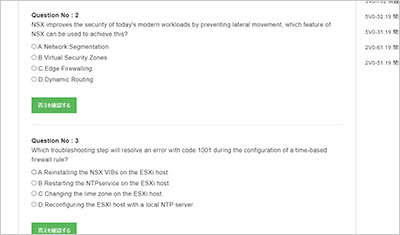
サンプル問題 1: Which two choices are solutions offered by the VMware NSX portfolio? (Choose two.)
A: VMware Tanzu Kubernetes Grid
B: VMware Tanzu Kubernetes Cluster
C: VMware NSX Advanced Load Balancer
D: VMware NSX Distributed IDS/IPS
E: VMware Aria Automation
正解:C, D
Explanation: VMware NSX is a portfolio of networking and security solutions that enables consistent policy, operations, and automation across multiple cloud environments1 The VMware NSX portfolio includes the following solutions: VMware NSX Data Center: A platform for data center network virtualization and security that delivers a complete L2-L7 networking stack and overlay services for any workload1 VMware NSX Cloud: A service that extends consistent networking and security to public clouds such as AWS and Azure1 VMware NSX Advanced Load Balancer: A solution that provides load balancing, web application firewall, analytics, and monitoring for applications across any cloud12 VMware NSX Distributed IDS/IPS: A feature that provides distributed intrusion detection and prevention for workloads across any cloud12 VMware NSX Intelligence: A service that provides planning, observability, and intelligence for network and micro-segmentation1 VMware NSX Federation: A capability that enables multi-site networking and security management with consistent policy and operational state synchronization1 VMware NSX Service Mesh: A service that connects, secures, and monitors microservices across multiple clusters and clouds1 VMware NSX for Horizon: A solution that delivers secure desktops and applications across any device, location, or network1 VMware NSX for vSphere: A solution that provides network agility and security for vSphere environments with a built-in console in vCenter1 VMware NSX-T Data Center: A platform for cloud-native applications that supports containers, Kubernetes, bare metal hosts, and multi-hypervisor environments1 VMware Tanzu Kubernetes Grid and VMware Tanzu Kubernetes Cluster are not part of the VMware NSX portfolio. They are solutions for running Kubernetes clusters on any cloud3 VMware Aria Automation is not a real product name. It is a fictional name that does not exist in the VMware portfolio. https://blogs.vmware.com/networkvirtualization/2020/01/nsx-hero.html/
サンプル問題 2: A company Is deploying NSX micro-segmentation in their vSphere environment to secure a simple application composed of web. app, and database tiers. The naming convention will be: • WKS-WEB-SRV-XXX • WKY-APP-SRR-XXX • WKI-DB-SRR-XXX What is the optimal way to group them to enforce security policies from NSX?
A: Use Edge as a firewall between tiers.
B: Do a service insertion to accomplish the task.
C: Group all by means of tags membership.
D: Create an Ethernet based security policy.
正解:C
Explanation: The answer is C. Group all by means of tags membership. Tags are metadata that can be applied to physical servers, virtual machines, logical ports, and logical segments in NSX. Tags can be used for dynamic security group membership, which allows for granular and flexible enforcement of security policies based on various criteria1 In the scenario, the company is deploying NSX micro-segmentation to secure a simple application composed of web, app, and database tiers. The naming convention will be: WKS-WEB-SRV-XXX WKY-APP-SRR-XXX WKI-DB-SRR-XXX The optimal way to group them to enforce security policies from NSX is to use tags membership. For example, the company can create three tags: Web, App, and DB, and assign them to the corresponding VMs based on their names. Then, the company can create three security groups: Web-SG, App-SG, and DB-SG, and use the tags as the membership criteria. Finally, the company can create and apply security policies to the security groups based on the desired rules and actions2 Using tags membership has several advantages over the other options: It is more scalable and dynamic than using Edge as a firewall between tiers. Edge firewall is a centralized solution that can create bottlenecks and performance issues when handling large amounts of traffic3 It is more simple and efficient than doing a service insertion to accomplish the task. Service insertion is a feature that allows for integrating third-party services with NSX, such as antivirus or intrusion prevention systems. Service insertion is not necessary for basic micro-segmentation and can introduce additional complexity and overhead. It is more flexible and granular than creating an Ethernet based security policy. Ethernet based security policy is a type of policy that uses MAC addresses as the source or destination criteria. Ethernet based security policy is limited by the scope of layer 2 domains and does not support logical constructs such as segments or groups. To learn more about tags membership and how to use it for micro-segmentation in NSX, you can refer to the following resources: VMware NSX Documentation: Security Tag 1 VMware NSX Micro-segmentation Day 1: Chapter 4 - Security Policy Design 2 VMware NSX 4.x Professional: Security Groups VMware NSX 4.x Professional: Security Policies
サンプル問題 3: When collecting support bundles through NSX Manager, which files should be excluded for potentially containing sensitive information?
A: Controller Files
B: Management Files
C: Core Files
D: Audit Files
正解:C
Explanation: According to the VMware NSX Documentation1, core files and audit logs can contain sensitive information and should be excluded from the support bundle unless requested by VMware technical support. Controller files and management files are not mentioned as containing sensitive information. Reference: 1: Support Bundle Collection Tool - VMware Docs Core files and Audit logs might contain sensitive information such as passwords or encryption keys. https://docs.vmware.com/en/VMware-NSX/4.1/administration/GUID-73D9AF0D-4000-4EF2-AC66-6572AD1A0B30.html
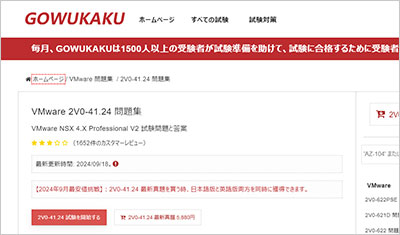
試験はこの世界で成功しやすいことの一つです。試験は前もって範囲を教えていますから、復習はこの範囲内の自分ができないところを探し続けています。GOWUKAKUは2V0-41.24問題集を用いた2V0-41.24(VMware NSX 4.X Professional V2)試験の復習方法を案内しています。